Shadowing practice: Utilitarianism: Crash Course Philosophy #36
 Listen to the line, then say it out loud
Full transcript
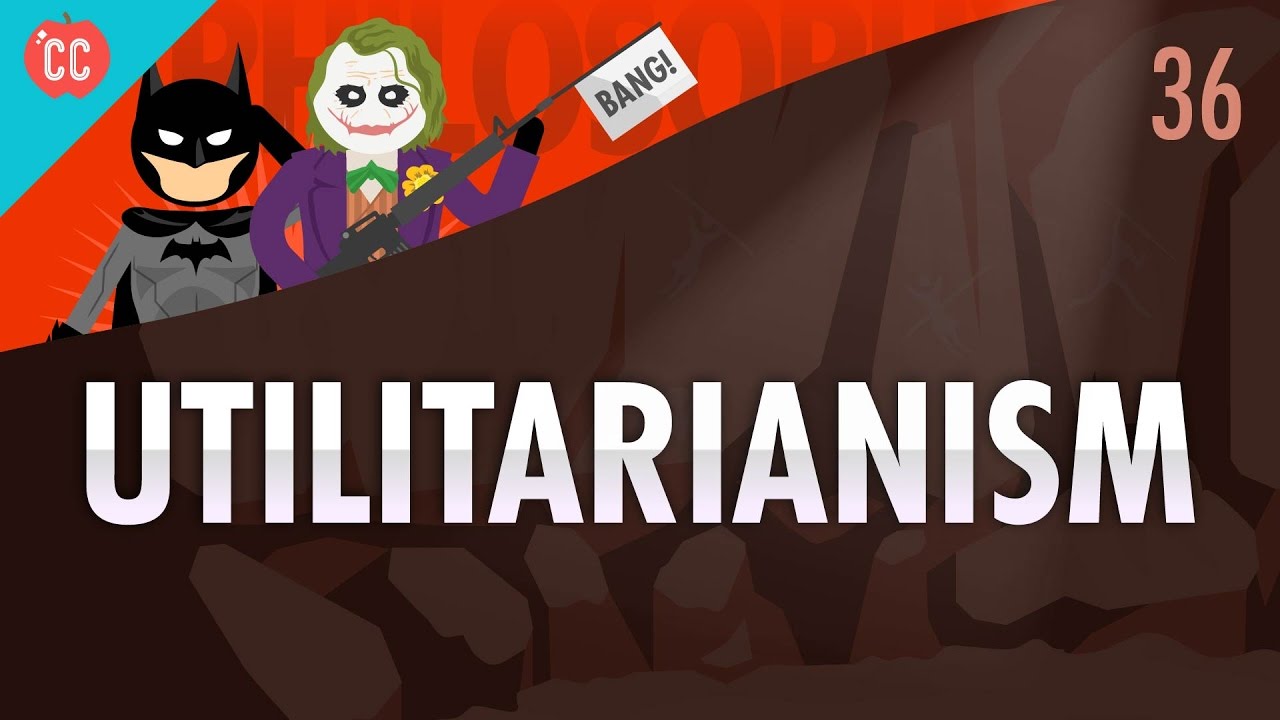
- INTRO Should Batman kill the Joker?0:00
- If you were to ask the Dark Knight himself, with his hard and fast no -killing rule, he'd say absolutely not.0:04
- Actually, in fact, he would say absolutely not.0:10
- When you think about it, dude is pretty Kantian in his ethics.0:13
- Regardless of what Joker does, there are some lines that good people do not cross.0:16
- And for Batman, killing definitely falls on the wrong side of that line.0:21
- But let's be real here.0:25
- Joker is never gonna stop killing.0:26
- Sure, Batman will have him thrown back in Arkham, but we all know that he's gonna get out.0:28
- He always gets out, and once he's free, he will kill again, and maim, and terrorize.0:33
- And when he does, won't a little bit of that be Batman's fault?0:40
- Batman has been in a position to kill the Joker hundreds of times.0:44
Show all 133 lines Show fewer lines
- He has had the power to save anyone from ever being a victim of the Joker again.0:47
- If you have the ability to stop a killer and you don't, are you morally pure because you didn't kill?0:53
- Or are you morally dirty because you refused to do what needs to be done?0:59
- So, why do I describe Batman as Kantian?1:14
- Well, the school of thought laid out by 18th century German philosopher Emanuel Kant, now known as Kantianism, is pretty straightforward.1:18
- More precisely, it's absolute.1:24
- Kantianism is all about sticking to the moral rule book.1:26
- There are never any exceptions or any excuses for violating moral rules.1:29
- And our man Batman tries his hardest to stick to his code, no matter what.1:33
- But there are other ways of looking at ethics.1:38
- Like instead of focusing on the intent behind our behavior, what if we paid more attention to the consequences?1:40
- One moral theory that does this is utilitarianism.1:45
- It focuses on the results, or consequences, of our actions, and treats intentions as irrelevant.1:47
- Good consequences equal good actions in this field.1:53
- So what's a good consequence?1:56
- Modern utilitarianism was founded in the 18th century by British philosophers Jeremy Bentham and John Stuart Mill, but the theory has philosophical ancestors in ancient Greek thinkers such as Epicurus.1:58
- All of these guys agreed that actions should be measured in terms of the happiness or pleasure that they produce.2:08
- After all, they argued happiness is our final end.2:14
- It's what we do everything else for.2:17
- Think about it like this.2:19
- Many things that you do, you do for the sake of something else.2:20
- You study to get a good grade, you work to get money.2:23
- But why do you want good grades or money?2:26
- There are different answers we could give, like maybe we're seeking affirmation for our intelligence or the approval of our parents or a degree that will give us a career2:29
- that we want.2:36
- But why do we want that particular career?2:37
- Why do we want approval?2:39
- We can keep asking these questions, but ultimately our answer will bottom out in, I want what I want because I think it will make me happy.2:40
- That's what we all want.2:47
- It's one of the few things everyone has in common.2:49
- And utilitarians believe that's what should drive our morality.2:51
- Like Kant, utilitarians agree that a moral theory should apply equally to everyone, but they thought the way to do that was to ground it in something that's really intuitive,2:55
- and there's really nothing more basic than the primal desire to seek pleasure and avoid pain.3:04
- So it's often said that utilitarianism is a hedonistic moral theory.3:08
- This means the good is equal to the pleasant, and we ought morally to pursue pleasure and happiness and work to avoid pain.3:12
- But utilitarianism is not what you'd call an egoistic theory.3:20
- Egoism says that everyone ought morally to pursue their own good.3:24
- In contrast to that, utilitarianism is other regarding.3:28
- It says that we should pursue pleasure or happiness, not just for ourselves, but for as many sentient beings as possible.3:31
- To put it formally, we should act always so as to produce the greatest good for the greatest number.3:38
- This is known as the principle of utility.3:43
- Okay, so no one's gonna argue with a philosophy that tells them to seek pleasure.3:46
- But sometimes doing what provides the most pleasure to the most people can mean that you have to take one for the team.3:50
- It can mean sacrificing your pleasure in order to produce more good overall.3:57
- Like when it's your birthday and your family says you can choose any restaurant you want.4:01
- The thing that would make you happiest is Thai food, but you know that that would make the rest of your family miserable.4:04
- So when you choose Chinese, which is nobody's favorite, but everybody can make do, then you've thought like a utilitarian.4:09
- You've chosen the action that would produce the most overall happiness for the group, even though it produced less happiness for you than other alternatives would have.4:15
- The problem is, for the most part, we're all our own biggest fans.4:22
- We each come preloaded with a bias in favor of our own interests.4:26
- This isn't necessarily a bad thing.4:29
- Caring about yourself is a good way to promote survival.4:31
- But where morality is concerned, utilitarians argue as special as you are, you are no more special than anybody else.4:34
- So your interests count, but no more than anyone else's.4:40
- Now, you might say you agree with that.4:43
- I mean, we all like to think of ourselves as being generous and selfless.4:45
- But even though I'm sure you are a totally nice person, you have to admit that things seem way more important.4:48
- Way to your higher stakes when they apply to you rather than to some stranger.4:54
- So utilitarians suggest that we make our moral decisions from the position of a benevolent, disinterested spectator.4:59
- Rather than thinking about what I should do, they suggest that I consider what I would think if I were advising a group of strangers about what they should do.5:05
- That way, I have a disposition of goodwill, but I'm not emotionally invested, and I'm a spectator rather than a participant.5:13
- This approach is far more likely to yield a fair and unbiased judgment about what's really best for the group.5:19
- Now, to see utilitarianism put to the test, let's pop over to the Thought Bubble for some flash philosophy.5:25
- 20th century British philosopher Bernard Williams offered this thought experiment.5:30
- Jim is on a botanical expedition in South America when he happens upon a group of 20 indigenous people and the group of soldiers.5:35
- The whole group of indigenous people is about to be executed for protesting their oppressive regime.5:42
- For some reason, the leader of the soldiers offers Jim the chance to shoot one of the prisoners since he's a guest in their land.5:48
- He says that if Jim shoots one of the prisoners, he'll let the other 19 go.5:54
- But if Jim refuses, then the soldiers will shoot all 20 protesters.5:59
- What should Jim do?6:03
- More importantly, what would you do?6:04
- Williams actually presents this case as a critique of utilitarianism.6:07
- The theory clearly demands that Jim shoot one man so that 19 will be saved.6:10
- But Williams argues no moral theory ought to demand the taking of an innocent life.6:15
- Thinking like a Kantian, Williams argues that it's not Jim's fault that the head soldier is a total dirtbag, and Jim shouldn't have to get literal blood on his hands6:20
- to try and rectify the situation.6:28
- So although it sounds pretty simple, utilitarianism is a really demanding moral theory.6:30
- It says we live in a world where sometimes people do terrible things, and if we're the ones who happen to be there and we can do something to make6:34
- things better, we must, even if that means getting our hands dirty.6:41
- And if I sit by and watch something bad happen when I could have prevented it, my hands are dirty anyway.6:45
- So Jim shouldn't think about it as killing one man.6:51
- That man was dead already because they were all about to be killed.6:53
- Instead, Jim should think of his decision as doing what it takes to save 19.6:56
- And Batman needs to kill the Joker already.7:01
- Thanks, Thought Bubble.7:04
- Now, if you decide you want to follow utilitarian moral theory, you have options.7:05
- Specifically, two of them.7:10
- When Bentham and Mill first proposed their moral theory, it was in a form now known as act utilitarianism, sometimes called classical utilitarianism.7:11
- And it says that in any given situation, you should choose the action that produces the greatest good for the greatest number, period.7:19
- But sometimes the act that will produce the greatest good for the greatest number can seem just wrong.7:25
- For instance, suppose a surgeon has five patients all waiting for transplants.7:30
- One needs a heart, another a lung, two are waiting for kidneys, and the last needs a liver.7:34
- The doctor is pretty sure that these patients will all die before their names come up on the transplant list, and he just so happens to have a neighbor who7:38
- has no family, total recluse, not even a very nice guy.7:45
- The doctor knows that no one would miss the guy if he were to disappear, and by some miracle, the neighbor is a match for all five of the transplant7:49
- patients.7:56
- So it seems like, even though this would be a bad day for the neighbor, an act utilitarian should kill the neighbor and give his organs to the five patients.7:56
- It's the greatest good for the greatest number.8:04
- Yes, one innocent person dies, but five innocent people are saved.8:06
- This might seem harsh, but remember that pain is pain regardless of who's experiencing it.8:10
- So the death of the neighbor would be no worse than the death of any of those patients dying on the transplant list.8:15
- In fact, it's five times less bad than all five of their deaths.8:20
- So thought experiments like this one led some utilitarians to come up with another framework for their theory.8:24
- This one is called rule utilitarianism.8:29
- This version of the theory says that we ought to live by rules that, in general, are likely to lead to the greatest good for the greatest number.8:32
- So yes, there are going to be situations where killing an innocent person will lead to the greatest good for the greatest number.8:39
- But rule utilitarians want us to think long -term and on a larger scale.8:45
- And overall, a whole society where innocent people are taken off the streets to be harvested for their organs is going to have a lot less utility than one where8:49
- you don't have to live in constant fear of that happening to you.8:57
- So rule utilitarianism allows us to refrain from acts that might maximize utility in the short run, and instead follow rules that will maximize utility for the majority of the9:00
- time.9:09
- As an owner of human organs, this approach might make sense to you.9:10
- But I still gotta say, if Batman were a utilitarian of either kind, it wouldn't look very good for the Joker.9:13
- Today, we learned about utilitarianism.9:19
- We studied the principle of utility and learned about the difference between act and rule utilitarianism.9:21
- Next time, we'll take a look at another moral theory, contractarianism.9:27
- Crash Course Philosophy is produced in association with PBS Digital Studios.9:31
- You can head over to their channel and check out a playlist of the latest episodes from shows like The Good Stuff, Gross Science, and PBS Idea Channel.9:35
- This episode of Crash Course was filmed in the Dr.9:42
- Cheryl C.9:43
- Kinney Crash Course Studio with the help of all of these awesome people, and our equally fantastic graphics team is Thought Cafe.9:44
A 212 wpm American lecture on Batman and Kant: english listening practice that pushes your speed
Use this one for english listening practice at speed. Crash Course Philosophy #36 is a scripted lecture read by a single American voice at 212 words per minute, faster than 71% of the clips in our catalogue. There are 133 lines. The level is B2, so the sentences get long before the vocabulary gets hard.
The opening is not abstract. It asks whether Batman should kill the Joker, calls him "pretty Kantian in his ethics", and uses that to walk into utilitarianism, Bentham, Mill and Epicurus. So you get two registers in one recording: the casual aside, "But let's be real here.", and the tidy academic definition a few lines later. That mix is what a seminar or an exam listening section actually sounds like, and it is why this clip is worth speaking rather than only hearing.
The delivery is even and well articulated, with almost no hesitation. That helps. At this pace nothing is slurred beyond recognition, but you still have to move your mouth quickly to keep up. Words like disinterested, unbiased, affirmation, maim, sentient and maximize are here to be said out loud, not just recognised.
Reductions and stress in the Joker lines: american accent training on real academic speech
Three lines carry most of the american accent training value in this opening. Read each one aloud before you look at the note under it.
- "Joker is never gonna stop killing." One of three gonna reductions in this recording. The stress sits on never and stop, and gonna almost vanishes between them. Say it with going to and the line is already slower than the speaker.
- "He always gets out, and once he's free, he will kill again, and maim, and terrorize." A list built on and. Each and is unstressed and short, while kill, maim and terrorize each take a beat. That is the rhythm to copy: strong content word, weak joiner, strong content word.
- "Kantianism is all about sticking to the moral rule book." Four words at the end, the moral rule book, spoken as one unit with one main stress. Learners usually break it into four equal pieces. It is not four equal pieces.
How to shadow this Crash Course lecture line by line and improve your english speaking
Turn the lecture into english speaking practice in short passes instead of playing the whole thing. Shadow this line, then the next one, and only then string them together. It is free, it runs in the app, and four lines a day is enough.
- Start on the short ones. "But let's be real here." and "So what's a good consequence?" are five words each and give you the speaker's tone with no memory load.
- Move to the gonna pair, lines 8 and 9. Repeat "Joker is never gonna stop killing." five times until gonna costs you nothing, then take the longer Arkham sentence next to it.
- Then a definition sentence: "It focuses on the results, or consequences, of our actions, and treats intentions as irrelevant." Keep the commas around or consequences as real pauses, the way he does.
- Finish on "Good consequences equal good actions in this field." and "It's what we do everything else for." Both close a point, and the pitch falls at the end of each.
- Then run the first fifteen lines once at full speed with the score visible, and repeat only what came back red.