Shadowing practice: How Do Gems Form?: Crash Course Geology #7
 Listen to the line, then say it out loud
Full transcript
- Let's go to ancient Egypt.0:00
- This is the Egyptian pharaoh Tutankhamun, AKA King Tut.0:01
- And this was found inside his tomb.0:05
- It's an ornate breastplate, and the piece de resistance is that gemstone in the middle.0:08
- It depicts the God Ra as a beetle.0:13
- But what kind of gem is it?0:16
- And how did it form?0:17
- For decades after the tomb's discovery in 1922, no geologist could find a solid answer.0:19
- But now we have one.0:24
- That gem formed because of a rock from space.0:25
- Hi, I'm Sage, and this is Crash Course Geology.0:30
- They sparkle, they shine, and sometimes they're found in a literal treasure trove.0:38
Show all 130 lines Show fewer lines
- I'm talking about gems.0:43
- We value these stones for their distinctive qualities.0:45
- They're hard to break, hard to find, and simply beautiful, and they can be made of a bunch of different stuff.0:48
- Most often, they're composed of minerals, those inorganic materials that make up things like quartz, ruby, and garnet.0:53
- Minerals have a specific crystal and structure.1:00
- They're made of atoms that are arranged in an orderly repeating pattern.1:02
- So that makes all minerals crystals.1:06
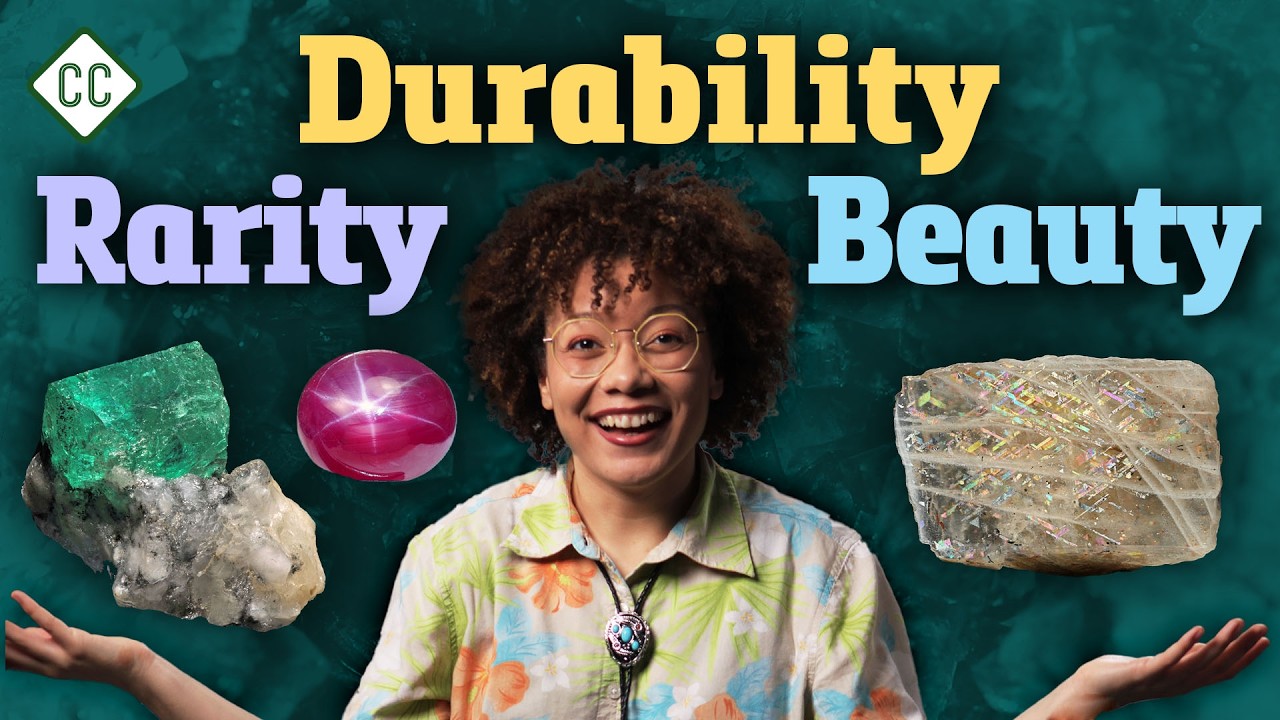
- And when a crystal is valued specifically for its durability, rarity, and beauty, we call it a gem.1:08
- No, Dwayne, you're not a gemstone.1:14
- Yes, I still love you just the way you are.1:17
- But gems can also be made of other stuff, including organic materials that come from living creatures, like a pearl from an oyster or a petrified wood from a tree.1:19
- It all depends on what we deem valuable.1:28
- Because of those qualities, people have been entranced by gems for a long, long time, coveting them, wearing them, attributing powers and curses to them, stealing them from palaces, graves,1:30
- and renowned Parisian museums.1:41
- Like, people across the globe have treasured opals for centuries.1:44
- Some indigenous Australians believe that they were left behind in the footprints of the creator who rode to Earth on a rainbow.1:47
- So maybe it's no surprise.1:54
- We've always wondered where they came from in the first place.1:55
- Or that Taylor Swift named a song after them.1:57
- Technically, the song is Opalite, and Opalite is man -made.2:00
- This was a whole thing in the writer's room.2:02
- They were swifty on Swifty Violence.2:04
- We don't have time for it right now.2:05
- We curious humans have been studying gems for thousands of years, trying to figure out why and how they form.2:07
- Like, way back in the 70s, CE, Roman philosopher Pliny the Elder was the gemstone expert.2:12
- Some of his ideas were right, but he did say that you could only break a diamond by hammering it with a tool that had been soaked in goat's blood.2:18
- So, no.2:25
- Grain of salts.2:26
- But for a long time, that research was mostly guesswork.2:28
- It took new technologies for us to find the answers we were searching for.2:31
- Let's dig a little deeper.2:35
- After the discovery of King Tut's tomb, it took another decade for someone to discover a similar gem in nature.2:37
- British surveyor Patrick Clayton found a bunch of yellow green stones in a part of the Sahara called the Great Sand Sea along the border of Egypt and Libya.2:42
- He assumed it was a type of quartz.2:50
- Later, the gem became known as Libyan Desert Glass.2:51
- Geologists had a wide range of wild theories about the glass's origins, from lightning strikes to lunar volcanoes.2:54
- As technology advanced, scientists have slowly teased out some clues.3:00
- For one, researchers estimated that the Libyan Desert Glass was about 28 million years old.3:04
- They uncovered evidence of its high pressure and high temperature beginnings, so high that some of the minerals within the glass, like the dark streaks of Christobalite, couldn't have possibly3:10
- formed from ordinary happenings on Earth.3:19
- They found chemical traces that suggest bits of iron from within the gem weren't from our planet.3:22
- Essentially, the gem likely formed from meteorites slamming into desert sand, causing the sand to melt and re -crystallize along with those mysterious dark streaks.3:28
- Put another way, the very same gem that was buried with an Egyptian king likely came from Earth tangoing with a space rock.3:38
- But the mystery hasn't been completely solved.3:44
- Some researchers think that the meteorite didn't actually hit Earth's surface, but rather broke apart in a low -altitude explosion above it.3:47
- Though there's still much to learn, it's safe to say that we know a lot more about gems than we used to.3:54
- Gemologists, scientists who study gems, use the Mohs hardness scale to measure a gem's hardness, or resistance to scratching.3:58
- They also study gems' toughness, or resistance to chipping, or fracturing, and their stability, or resistance to heat, chemicals, and light that can cause a gem's color to fade.4:05
- Side note, you might have heard gems described as semi -precious or precious supposedly based on their rarity.4:15
- But don't let those words fool you.4:20
- There are so many exceptions to the rule, those labels are basically meaningless.4:22
- Like, diamonds are considered precious gems, but depending on the type, they could be worth less than supposedly semi -precious garnet.4:26
- Aside from color, we've also ironed out some other qualities of gems, like brilliance, luster, transparency, and fire.4:33
- Wow, Dwayne, you are dazzling!4:40
- Did you get some work done?4:43
- Modern geology has helped us learn a lot about where gems come from.4:44
- They can form in many different ways, not just by meteoric explosion, or your pet rock, bedazzling itself.4:48
- Some gems come from lightning, like fulgricht, which forms when lightning strikes sand.4:54
- And a lot of gemstones, like emerald, aquamarine, and topaz, form as molten rock cools super slowly underground.4:59
- Other gems form similarly to how… rock candy is made, just with minerals instead of sugar.5:07
- Hot water circulates through deep cracks in earth's surface, dissolving minerals as it flows.5:14
- When water eventually cools down, crystals like quartz and fluoride can begin to grow.5:19
- Don't eat gems, though.5:24
- Even when they look delicious.5:25
- And if crystals form in cavities underground, you've got yourself a geode, a hunk of rock lined with crystals on the inside.5:27
- When layers of rock above it eventually wear away, that ball of crystals reaches the surface.5:34
- Then you can crack that puppy open and see what sparkles inside.5:39
- No, no, no, don't worry.5:42
- I wouldn't crack you open.5:43
- Also, you're not a geode.5:44
- There's nothing in there.5:45
- However they form, minerals all need the same basic things.5:46
- The right temperature, pressure, time, space, and ingredients.5:50
- Lots of those ingredients are pretty common chemical elements, like silicon, carbon, and oxygen.5:55
- But sometimes tiny traces of other elements get in there.5:59
- Those impurities are often what determine a gemstone's color, which can sometimes change its name.6:03
- Ruby and sapphire, two paragons of gem high society, are actually just different colors of the same mineral, corundum.6:07
- Other weird stuff can happen to baby gemstones, too.6:14
- Like the different colored bands in this watermelon tourmaline formed when the environment around the growing crystals shifted.6:17
- Or sometimes different fluids or gases get trapped in the crystal, creating inclusions like the needle -thin hairs of the mineral rutile that form the star in this star ruby.6:23
- Inclusions can also offer us information about where the gem formed, geographically.6:34
- For example, we can tell certain emeralds come from Colombia because of parasite inclusions in them.6:39
- It's a type of mineral, not a flesh -eating bug.6:43
- The more we humans learn about gems, the more fascinated we become.6:46
- People today are just as into them as old King Tut.6:49
- Maybe even more.6:51
- As of 2025, gemstones were a $36 billion industry, and the value of individual gems can really vary.6:52
- Often gem sellers cut and polish them for sale, creating flat surfaces called facets that can enhance those beautiful qualities like brilliance and fire.7:01
- On the other hand, inclusions can make gems less valuable.7:09
- Unless they're really cool looking, like this rainbow lot of sunstone.7:12
- But as early as the 1870s, scientists have tried to get around those long, complex geological processes by making their own gems.7:15
- Imitation gems known as simulants are made of materials that only look like certain gems.7:22
- Think glass cut into the shape of a diamond, or a hunk of granite covered in rhinestones.7:26
- No, I said you looked great.7:31
- But we've also harnessed science to grow gems that are so much like the real thing that they kind of are.7:33
- These synthetic gems are grown in a lab by mimicking the conditions in which gems grow in the wild.7:39
- But the lab is way more efficient.7:45
- In nature, rubies grow over millions of years.7:47
- But in the lab, they can grow in as little as three hours.7:50
- You also don't have to dig them out of the ground, which makes them a lot easier to combat.7:55
- People still prize natural gems.8:00
- The proof is in the price tag.8:02
- But many are turning to synthetics as a more sustainable option.8:03
- Processes that create synthetic gems don't use or degrade merely as much land as natural mining does, though they do require a lot of energy.8:06
- And gem mining can sometimes coincide with human rights abuses, like forced labor and displacement of indigenous peoples.8:14
- These considerations are big and very complex.8:22
- We've shared some resources below to dig deeper.8:25
- As for how to tell if a gem was made inside the earth or in a lab, well, the average shopper probably can't.8:28
- High -end gem dealers often send their wares to experts who use tools like microscopes, UV lamps, lasers, and x -rays to tell a difference.8:34
- Whether we're coveting the sparkly jewelry worn by celebs at the Met Gala, or perusing the crystal stand at the farmer's market, we humans are mesmerized by gems.8:42
- And that connects us to the people of the past who saw just as much beauty in them as we do today.8:52
- As we move into the future of the gem trade, we'll have to ask ourselves even more questions about what we value and why.8:57
- Next time, we'll talk about one very special gem.9:04
- Dibons!9:08
- I'll uh...9:09
- See you then!9:10
- Thanks for watching this episode of Crash Course Geology, which was filmed at our studio in Indianapolis, Indiana, was made with the help of these rockin' people.9:12
- If you want to help keep Crash Course free for everyone, forever, you can join our community on Patreon.9:19
English Listening Practice with an American Science Lecture on How Gems Form
This clip opens Crash Course Geology's episode on gems, and it starts with a story rather than a definition. Host Sage takes you inside King Tutankhamun's tomb before the word mineral ever comes up. The pace sits at 206 words per minute, faster than most of the catalogue, so this suits a learner who already has some ground under them rather than a first attempt at english listening practice.
The level is B2. You hear full sentences at lecture speed with the quick tonal shifts a teacher uses to hold a room: mock seriousness for the pharaoh's breastplate, then a sudden joke about a family member. That mix of register inside one short passage is what makes this worth practising speaking on, not only listening to.
American Accent Training on Sage's Quick Asides in Crash Course Geology
Sage's american accent stays clear and evenly paced through the explanatory lines, then speeds up and loosens for the jokes. That shift, more than any single word, is what to listen for if you want to improve your english accent on lecture material.
- "This is the Egyptian pharaoh Tutankhamun, AKA King Tut." runs the abbreviation AKA as one quick syllable string, not three letters said slowly, a useful target if you are working on how to pronounce english words that get compressed like this in fast speech.
- "That gem formed because of a rock from space." is the episode's whole thesis in nine words, delivered as a single breath group with the stress landing hard on rock and space.
- "No, Dwayne, you're not a gemstone." is a fast, informal aside dropped straight into an academic lecture, the kind of tonal swing that trips up learners used to flatter classroom English.
How to Shadow This Line by Line for B2 English Speaking Practice
Work the opening in order rather than jumping around. The jokes only land once you have heard the setup that comes before them, so build the passage up piece by piece.
- Start with "Let's go to ancient Egypt." on its own. Five words, said as a single unit, the shape you want before adding longer lines.
- Move to "This is the Egyptian pharaoh Tutankhamun, AKA King Tut." and shadow this line until the name and the abbreviation come out at Sage's speed, not yours.
- Take "That gem formed because of a rock from space." as a standalone drill. It is short enough to repeat five times in a row, and it is the line the whole segment is building toward.
- Shadow "No, Dwayne, you're not a gemstone." apart from the lecture lines around it, since the register change is the real difficulty here, not the vocabulary.
- Once those four hold together, run the full opening again at full speed to check the transitions between explanation and aside. That transition is the core english speaking practice this clip offers.