Shadowing practice: Ukraine is now the world's AI war lab | DW News
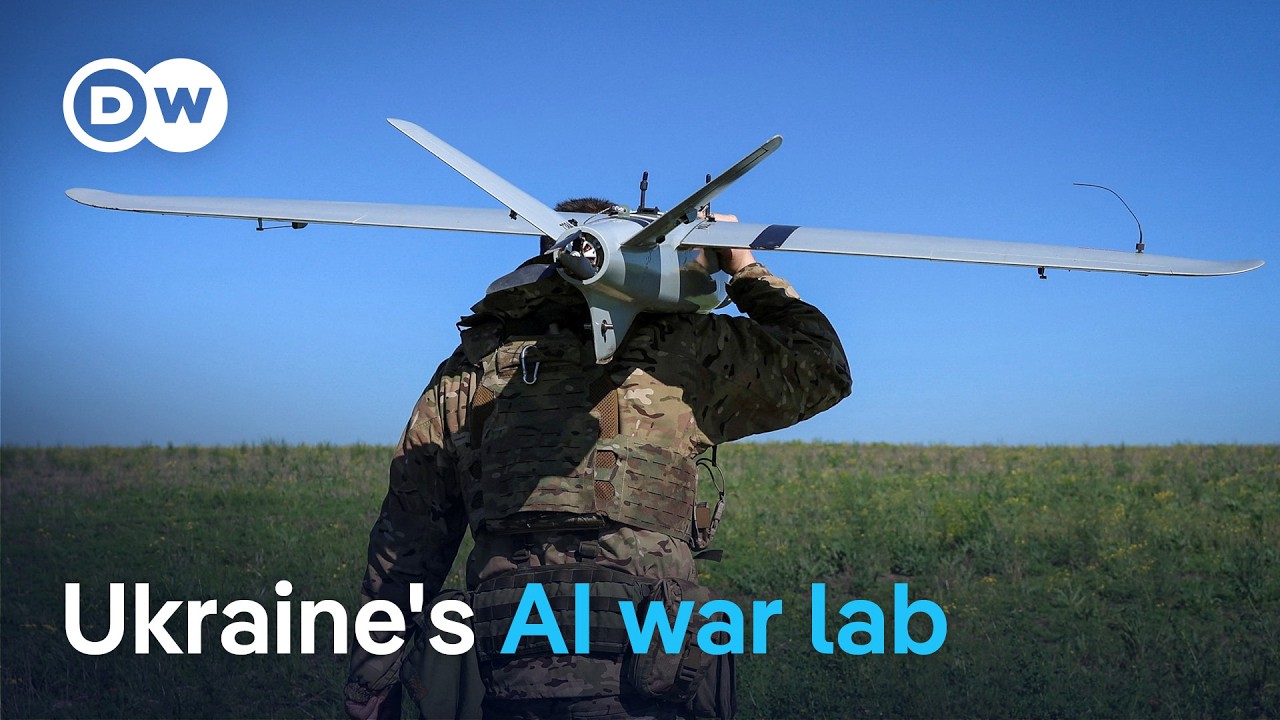 Listen to the line, then say it out loud
Full transcript
- In March of 2026, Ukraine did something no country has done before.0:00
- It opened an online portal, giving allied governments and defence companies direct access to more than two million hours of combat drone footage.0:05
- That's the equivalent of 228 years.0:14
- And every day, more than five terabytes of footage is added.0:17
- No one else has anything close to it.0:21
- Ukraine's motivation with this is straightforward.0:30
- Share their data with allies, help them build better autonomous weapons and in return, get smarter, faster AI tools for Ukraine's own front lines against Russia.0:32
- But the combat data portal is just the tip of the iceberg.0:43
- Underneath it is four years of hard -won battlefield experience that has turned made -in Ukraine expertise into a global export.0:47
- A few weeks ago, in the hallways of a Kiev office building, I was allowed into a startup workshop, only if I agreed to be blindfolded so as not to0:57
- know its true location.1:05
- These masked men were busy putting together little black boxes containing software called Cordyceps OS.1:10
Show all 99 lines Show fewer lines
- And yes, they're named after the Cordyceps -fungal zombie virus in the video game later adapted into a series on HBO.1:16
- But these Cordyceps, once attached to a combat drone, enable various software to be assigned to that drone while also allowing engineers to make adjustments remotely.1:23
- Before, if the drone needed, say, night vision and AI capability, it would have required multiple separate boxes.1:33
- But there's only so much space on a drone and so much weight it can take.1:41
- Putting it all in one box is an innovation that Alexander Bachmach, one of the founders of this startup, says was born out of necessity.1:45
- It demonstrates just how far this homegrown technology has come in only a few years' time.1:53
- At the beginning of the big invasion, people were searching just for tools that can protect themselves.2:00
- And the FPV was the first clever idea of how we can protect ourselves.2:06
- You have to attach the bomb to the FPV and you have the guided missile.2:12
- But there were the big disadvantage of this technology.2:16
- They require an interrupted direct link between the operator and the drone.2:19
- You lose the signal, you fall.2:24
- That's all.2:26
- And that was a problem because the main causes of signal loss was the electronic warfare of Russian electronic warfare.2:27
- I mean, it's radio waves, but yeah.2:36
- So it's a special zone in space where if you reach these zones, you have the signal loss, you lose the drone.2:39
- In the early days of Russia's full -scale invasion, Ukraine couldn't afford to lose any drones.2:46
- It had only seven manufacturers.2:51
- Today, there are over 500, making drone production a major part of its defence sector, now valued at nearly $7 billion.2:53
- So as we've seen, a major component of that comes from startups, organised in a more horizontal rather than top -down structure.3:02
- For us, it was clear that we cannot compete with Russia with the volume of resources.3:10
- We need to have the asymmetrical responses to Russian aggression and the technologies.3:15
- This is the key thing that helps Ukraine to fight with Russia.3:21
- We don't need to coordinate or manage.3:26
- We need to give freedom to Ukrainian companies, to Ukrainian innovators.3:30
- And they will do magic after that.3:34
- It's like mushrooms after the rain.3:36
- Brave One is the name for the umbrella platform connecting government funds, startups and front -line units.3:40
- CEO Andrey Hrytsyniuk says the testing programme is simple.3:47
- If your drone doesn't work at the front, brigades just won't buy it anymore, like any capitalist venture.3:51
- It's what many Ukrainians in this sector have taken to calling the innovation loop.3:57
- The soldier isn't just the end -user.4:02
- He or she is effectively telling them what to build.4:03
- Fourth Law, like dwarf engineering, is building similar box add -ons that help drones function, in this instance, autonomously.4:07
- And most of its design and function comes directly from the front lines.4:16
- It's about feedback.4:20
- It's about adaptation.4:21
- It's about implementation.4:23
- It's about very fast R &D process.4:24
- And all together, it's this innovation loop.4:26
- And you can copycat Ukrainian technology, like Ukrainian drone, and move it to Germany or to any other country and start producing it.4:29
- But in the next three, six months, this drone will be outdated.4:41
- We went to see one of Fourth Law's little black boxes in action.4:46
- Because the AI part of it all depends on this here, drone battlefield data.4:51
- In a normal drone, the pilot can't get into the target, but he's already controlling the computer.4:56
- The computer itself is targeting and expressing which zones are working in the enemy's rap.5:04
- To help the artificial intelligence, it flies through these zones and then when it's being controlled, it can fly further.5:09
- In addition to helping drones navigate Russian jamming zones, AI also speeds up processing time, making drone software smarter about what it hits and where for maximum fit.5:17
- One year ago, we were trying to attack a car, for example, but now we are attacking not a tank as a whole, but some types or some parts of5:29
- a tank.5:44
- So we understand where it should go and the probability of successful mission will be much more higher.5:45
- Our main task is to be fast, to use AI on each step between the first step and the final step, between the detection and the moment when we strike5:52
- the target, to use AI to speed up this process.6:02
- Which is what Ukrainian engineer Flame has already done.6:06
- The AI -driven software he and his colleagues developed analyses photo and video surveillance data to pinpoint Russian targets all on its own, shaving hours off the time it takes6:10
- to spot one.6:21
- These are the trenches and the masking features, so you can see the trench over here.6:22
- This is what is called the positive identification of the target and the human in the loop in this process, particularly human -makes decision, whether this is what machine claims6:28
- it to be or not.6:38
- The human in the loop is a phrase I heard a lot while reporting this story, but as these AI -driven combat drone systems become more capable, the question ultimately6:39
- becomes who decides to pull the trigger.6:49
- In Ukraine, it's still people.6:52
- The Chinese decision to target the target and to target the enemy is the pilot himself.6:54
- The pilot himself is forced to engage in the attack and the drone itself is the target that the pilot has.7:01
- We need to understand that AI system can provide you some type of solution and after that you will confirm it to execute.7:07
- So there is a difference between the providing scenario or recommendation, which is based on AI and actually about the execution of some action by the AI.7:18
- While the Ukraine's military insists their drone operations are still ultimately decided by humans, there is evidence that this has not always been the case with other countries, for example,7:30
- Israel in Gaza.7:40
- And this precedent, among others, has human rights organisations very concerned about the future.7:42
- The UN and others have been actively pushing for binding global rules to ensure accountability over military AI.7:48
- We must ensure human control over the user force.7:55
- Let us be clear, humanity's fate cannot be left to an algorithm.7:59
- For years Ukraine has been warning other countries to prepare for this kind of AI drone war.8:04
- And then it happened.8:11
- In February of this year the US and Israel launched strikes on Iran and suddenly several US allies in the Gulf were under Iranian attack.8:15
- Under siege by the same Russian Shah -Hed drones that Ukraine has spent years learning how to shoot down and at a fraction of the cost.8:24
- Within days President Zelensky sent more than 200 Ukrainian specialists to Saudi Arabia, the UAE, Kuwait and Qatar in order to help coordinate their air defence operations.8:32
- Zelensky also dispatched his defence minister to negotiate the sale of cutting -edge Ukrainian interceptor drones.8:44
- Quite the turnaround for a country that not long ago was begging allies for military support.8:51
- Now it's selling its equipment and expertise to the world.8:56
- Ukraine's data portal that I mentioned at the top is getting buy -ins too.9:00
- In April Germany became the first to formalise a bilateral deal.9:05
- With Zelensky and Chancellor Mertz in the room, their defence ministers signed Ukraine's first government -to -government data exchange part of a sweeping 4 billion euro defence package.9:09
- Others are expected to follow.9:20
- This is essentially an arms race and if the nation is not taking part in that they are essentially behind the technological progress and they are in danger.9:21
- I believe that the next development and enhancement of AI's can make AI the new nuclear weapon or even much stronger.9:30
- And the main goal that we have is to enhance and develop AI capabilities to the level that prevent starting of new wars.9:43
A fast C1 news report for english speaking practice
This clip opens a DW News report on Ukraine's combat drone data portal, and it mixes two speaking styles in one recording. A trained narrator delivers scripted lines about the portal and its footage totals, then the piece cuts to startup founder Alexander Bachmach speaking unscripted, accented English about why his team built Cordyceps OS. Rated C1 and running at 166 words per minute, it is quick, so it rewards learners who can already follow fast, unscripted English and want to keep pushing their speaking practice at that pace.
The content itself is current affairs and technology reporting: drone footage archives, electronic warfare, startup engineering. Words like asymmetrical, interceptor, bilateral and implementation sit inside ordinary sentences rather than being explained, which is normal for a C1 segment and good english listening practice. Because the narration and the interview alternate, you also get to compare a polished broadcast voice against an interviewee thinking out loud, which helps if you want to improve your english accent across registers, not just one speaker.
The lines worth repeating for english shadowing practice
Three lines in this opening carry very different rhythms, and working through them back to back trains you to shift pace the way native speakers do mid conversation.
- "That's the equivalent of 228 years." is a short, stressed sentence: the number carries the whole point, so the stress lands hard on "228 years" and the rest is almost thrown away.
- "No one else has anything close to it." is flat declarative English, useful for practising a falling pitch that still sounds confident rather than bored.
- "You lose the signal, you fall." and "That's all." are two short lines back to back; read them as separate breath groups, the first almost breathless, the second a flat, final beat.
- "And that was a problem because the main causes of signal loss was the electronic warfare of Russian electronic warfare." is Whisper's exact transcription of Bachmach thinking aloud, subject and verb do not agree, and repeating it as spoken, not corrected, is the point of practising unscripted speech aloud.
How to shadow this C1 interview and news clip
Work the narration and the interview separately before mixing them, since the two speakers ask for different mouths.
- Start with lines 1 to 5, the scripted opening, to lock onto the narrator's even pace before the numbers arrive.
- Isolate line 3, "That's the equivalent of 228 years.", and line 4, and repeat only the numbers until the stress is automatic.
- Read lines 6 to 9 as one breath group each, since line 7 is a single long sentence broken by commas rather than full stops.
- Move to lines 19 to 21 and slow down deliberately, matching Bachmach's unscripted delivery instead of the narrator's polish.
- Loop lines 23 to 26 five times, the run on explanation about signal loss, until the ungrammatical but natural rhythm stops feeling wrong.