Shadowing practice: Traffic Has a Perfect Solution. Humans Won't Use It.
 Listen to the line, then say it out loud
Full transcript
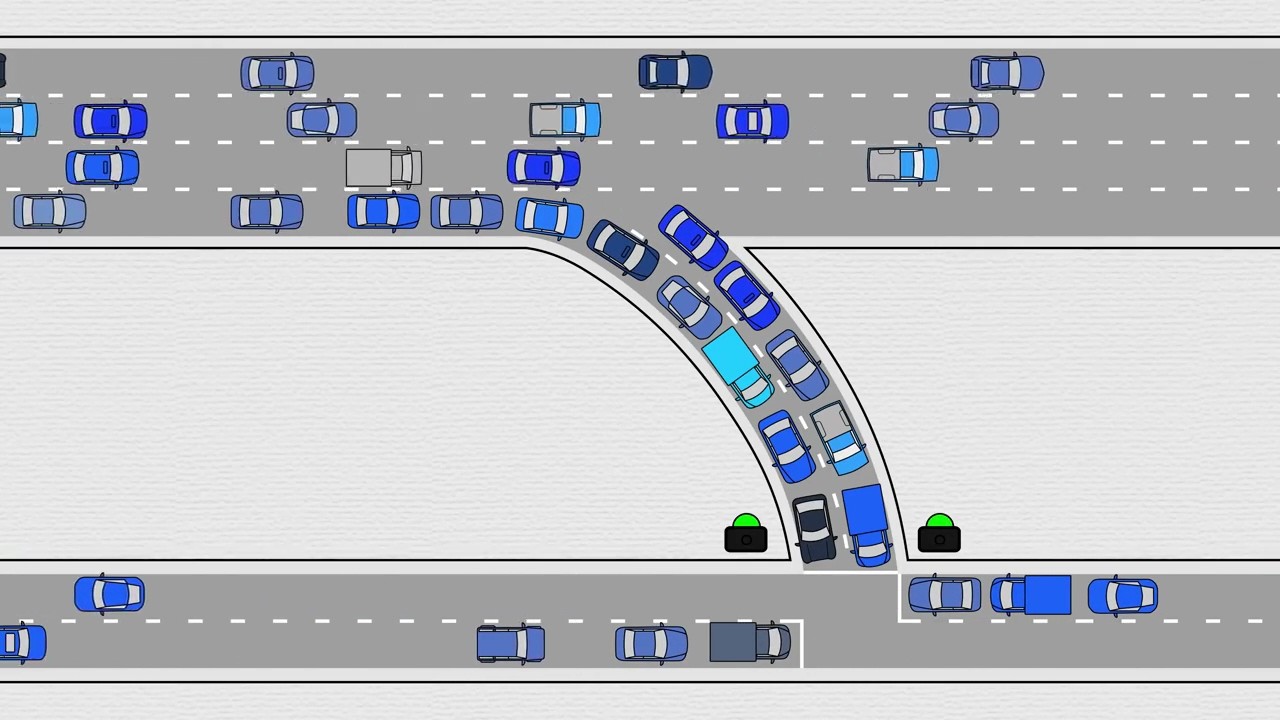
- Stuck at an intersection, you always watch unfold the fundamental problem of traffic.0:00
- On green, the first car accelerates, and then the next, and then the next, and then the next, and then you, only to catch the red.0:04
- Had the cars accelerated simultaneously, you would have made it through.0:12
- Coordination, not cars, is the problem, because we are monkey drivers, with slow reaction times and short attention spans.0:16
- Even if we tried, getting everyone to press the pedal on 3, 2, 1, now would be challenging.0:24
- This discoordination limits how many cars can get through an intersection, and when one backs up to the next, that's when city -sized gridlock cascades happen, taking forever to clear.0:30
- In general, more intersections equals more discoordination, which equals more traffic.0:40
- This is the motive behind big highways.0:44
- No intersections.0:46
- Splits and merges, yes, intersections, no.0:47
- No stopping, no coordination problems, no traffic.0:50
- Well, that's the theory anyway.0:53
Show all 59 lines Show fewer lines
- Intersections outside of a highway will back up onto it, again, because human reaction times limit how many cars can escape the off -ramp when the light changes.0:54
- But, even without intersections, there would still be traffic on the highway.1:02
- Traffic can just appear.1:06
- Take a one -lane highway with happy cars flowing until a chicken crosses the road.1:08
- The driver who sees it breaks a little, the driver behind him doesn't notice immediately and breaks a little harder than necessary, the driver behind him does the same until1:12
- someone comes to a complete stop.1:19
- And oh, look, cars approaching at highway speeds must now stop as well.1:21
- Though the chicken is long gone, it left a phantom intersection on the highway.1:25
- This is what's happened when you're stuck in traffic for hours thinking there must be a deadly pile up ahead, and then suddenly the traffic's over with no wreckage in1:30
- sight.1:37
- To your relief, if you're a good person and mild annoyance, if you aren't, you just pass through a phantom intersection, the cause of which is long gone.1:37
- And this phantom intersection moves.1:44
- It's really a traffic snake slithering down the road, eating oncoming cars at one end and pooping them out at the other.1:47
- On a ring road, a single car slowing down will start an eroberous of traffic that will last forever, even though there's no problem with the road.1:53
- If the drivers could coordinate to accelerate and separate simultaneously, easy driving would return, but they can't so traffic eternal.2:01
- On highways, traffic snakes grow if cars are eaten faster than excreted, and they shrink if excreted faster than eaten, dying when the last car accelerates away before the next2:09
- car must stop.2:18
- Now, in multi -lane highways, there needs to be no chicken to start gridlock.2:19
- A driver crossing lanes quickly with cars too close behind is enough to birth a traffic snake that lives for hours in leagues.2:22
- It's this quick crossing that causes drivers behind to overbreak and begin a chain reaction.2:29
- But we can make traffic snakes less likely by changing the way we drive.2:34
- Your goal as a driver is to stay the same distance from the car ahead as from the car behind at all times.2:39
- Tailgating is trouble, not just because it makes accidents more likely, but because you as the tailgater can start a traffic snake if the driver ahead breaks.2:45
- Always in the middle.2:53
- This gives you the most time to prevent overbreaking, but also gives the driver behind you the most time as well.2:54
- And when stuck in traffic, this rule would get all cars to pull apart the snake faster.3:00
- That's the simple solution to traffic, getting humans to change their behavior.3:06
- Perhaps by sharing this video to show how and why traffic happens, why tailgaters are trouble, and how we can work together to make the roads better for all.3:10
- The end.3:19
- Except, yeah, wishing upon a star that people are better than they are is a terrible solution every time.3:20
- Instead, what works is a structurally systematized solution, which is exactly what self -driving cars are.3:26
- Self -driving cars can just be programmed to stay in the middle and accelerate simultaneously.3:32
- They'll just do it.3:36
- The more self -driving cars and an intersection, the more efficient the intersection gets.3:37
- A solid lane of self -driving cars vastly increases throughput.3:41
- Hmm, actually.3:45
- If you ban humans from the road, which we should totally do anyway, you can get rid of the intersection entirely.3:47
- After all, a traffic light is just a tool for drivers on one road to communicate with drivers on another.3:52
- Poorly and coarsely.3:58
- Red equals don't go now, we are coming through the intersection.3:59
- Green equals good to go.4:02
- But self -driving cars can talk to each other at the speed of light.4:03
- With that kind of coordination, no traffic light necessary.4:07
- Just as with a highway, the best intersection is no intersection.4:10
- Humans will never drive this precisely.4:14
- At the intersection, the fundamental problem with traffic that you watch unfold, as with everything, is people.4:17
- So the real simple solution to traffic is no more monkeys driving cars.4:23
A brisk B2 monologue for american accent training: CGP Grey on traffic
This clip is a solid pick for american accent training and general english speaking practice at B2 level. CGP Grey narrates the whole thing alone, explaining why traffic jams form even without accidents, so you get one clean voice at 202 words per minute across 59 lines rather than two speakers trading turns. That pace is faster than most of the catalogue, so treat this as a stretch clip once shorter lines feel comfortable, not as a first attempt.
The content itself is closer to a lecture than a scene: Grey states an idea, such as the fact that stuck at an intersection you always watch unfold the fundamental problem of traffic, then complicates it a sentence later. That builds long, clause stacked sentences that are genuinely hard to say at speed, which is exactly why repeating them out loud is useful practice rather than busywork.
The run on sentences and rare words in the traffic monologue
Three lines are worth slowing down for before you try to match the pace.
- Line 1, "you always watch unfold the fundamental problem of traffic", inverts normal word order around the verb unfold. Say it slowly first so the stress lands on watch and unfold, not on problem.
- Line 4, "we are monkey drivers, with slow reaction times and short attention spans", is one long noun phrase tacked onto a short clause. Practise it as two chunks: the short claim, then the two paired descriptions.
- Line 25, "a traffic snake slithering down the road, eating oncoming cars at one end and pooping them out at the other", strings three participle phrases in a row (slithering, eating, pooping). The rare words slithering and pooping carry the joke, so give them slightly more weight than the connecting words around them.
- Line 20, "it left a phantom intersection on the highway", is short and flat by comparison. Use it as a recovery point between the two longer lines above it.
How to shadow this line by line: english shadowing practice for b2
The clip rewards working in order rather than jumping around, since each line sets up the next one's logic.
- Play lines 1 to 3 first and shadow them as a block: they set up the whole argument, from watching traffic at an intersection to the idea that simultaneous acceleration would have solved it.
- Take line 4 alone and repeat it five times before moving on. Its two stacked descriptions are the hardest single sentence in this opening stretch to say fluently.
- Loop lines 16 to 19, the chicken crossing the road example, at half speed once, then at full speed. This is the section that teaches you to speak english fluently under a fast, cause and effect narration instead of slow, isolated sentences.
- Shadow line 25 on its own last. It carries the rare vocabulary, slithering and pooping, so it is the line most worth recording yourself on and comparing against the original for pronunciation.
- Once lines 1 to 27 sound close to the original pace, restart from line 1 and run the whole stretch without stopping. That single unbroken pass is the real test of whether this english speaking practice session has stuck.