Практика английского по видео: The Most Controversial Problem in Philosophy
 Послушай фразу и повтори вслух
Фраза 1
Полный текст видео
- Do not hit the like button or the dislike button, at least not yet.0:00
- I want you to consider a problem that's been one of the most controversial in math and philosophy over the past 20 years.0:04
- There is no consensus answer, so I want you to listen to the problem and then vote for the answer you prefer using the like and dislike buttons.0:10
- Okay?0:19
- Here is the setup.0:20
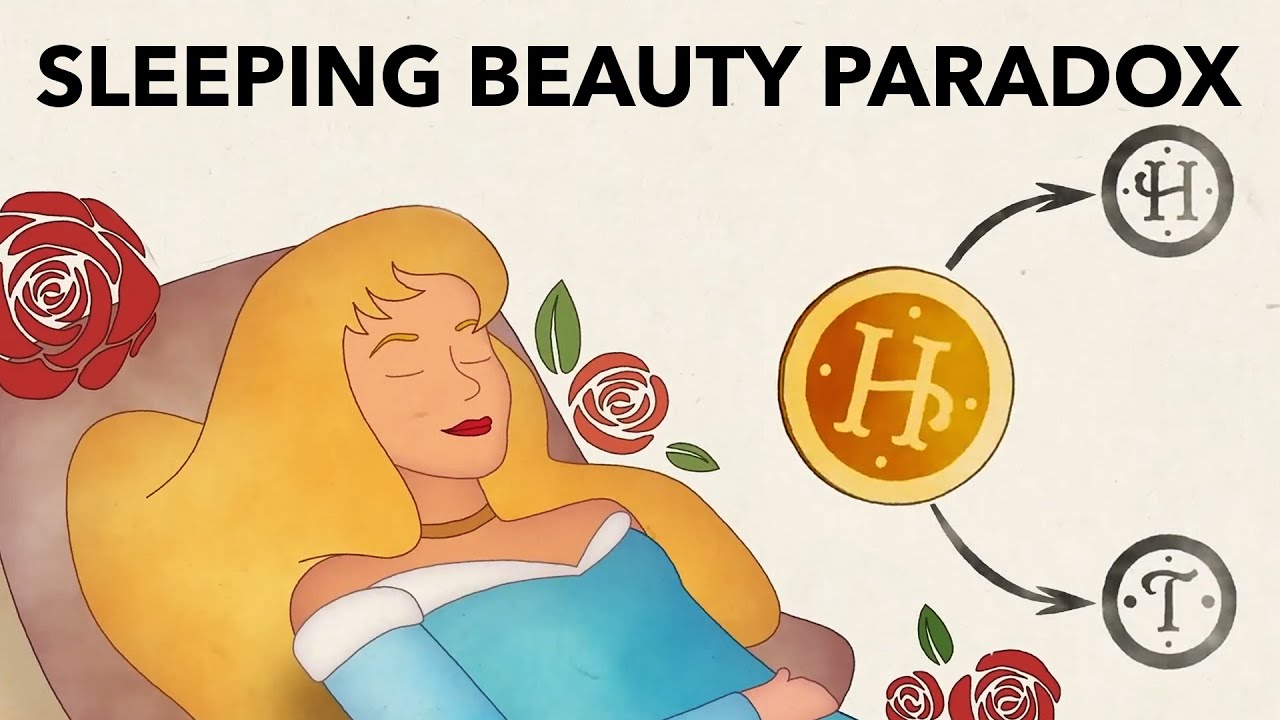
- Sleeping Beauty volunteers to be the subject of an experiment.0:22
- And before it starts, she's informed of the procedure.0:25
- On Sunday night, she will be put to sleep.0:28
- And then, a fair coin will be flipped.0:31
- If that coin comes up heads, she'll be awakened on Monday and then put back to sleep.0:34
- If the coin comes up tails, she will also be awakened on Monday and put back to sleep.0:39
- But then she'll be awakened on Tuesday as well and then put back to sleep.0:44
Показать все фразы (127) Свернуть
- Now each time she gets put back to sleep, she will forget that she was ever awakened.0:48
- In the brief period, anytime she's awake, she will be told no information.0:52
- But she'll be asked one question.0:58
- What do you believe is the probability that the coin came up heads?1:01
- So how should she answer?1:05
- Feel free to pause the video and answer the question for yourself right now.1:07
- This was my reaction after hearing the problem for the first time.1:12
- I mean, the intuitive answer that pops into my head is clearly one in three.1:16
- It could be the Monday when it came up heads, or it could be the Monday when it came up tails, or it could be the Tuesday when it came1:20
- up tails.1:29
- But you know what's really interesting is you just answered that the probability of a coin coming up heads is one third.1:31
- I think a lot of this comes down to what specific question is asked of her.1:35
- What is the probability that a fair coin flipped gives heads?1:39
- That's 50%.1:43
- What is the probability that the coin came up heads?1:44
- I would say the answer is a third from her perspective.1:48
- It's remarkably the same question.1:54
- The simple reason why Sleeping Beauty should say the probability of heads is one half is because she knows the coin is fair.1:56
- Nothing changes between when the coin is flipped and when she wakes up, and she knew for a fact that she would be woken up and she receives no new2:03
- information when that happens.2:10
- Imagine that instead of flipping the coin after she's asleep, the experimenters flip the coin first and ask her immediately.2:13
- What's the probability that the coin came up heads?2:21
- Well, she would certainly say one half.2:24
- So why should anything change after she goes to sleep and wakes up?2:26
- This is known as the Haffer position, but there is another way to look at it.2:30
- Others would argue that something does change when she's awakened.2:35
- I mean, it seems like she gets no new information.2:38
- There are no calendars, no entails or anything, and she knew that she would be woken up, but she actually learns something important.2:41
- She learns that she's gone from existing in a reality where there are two possible states.2:49
- The coin came up either heads or tails, to existing in a reality where there are three possible states.2:53
- Monday heads, Monday tails, or Tuesday tails.3:00
- And therefore, she should assign equal probability to each of these three outcomes where heads only occurred in one.3:03
- So the probability that the coin came up heads is one -third.3:10
- This is known as the thirder position.3:14
- Now, I know it seems wrong to suggest that a fair coin should have a one -third probability of coming up heads, but that's because the question she's asked is3:18
- subtly different.3:25
- The implied question is, given you're awake, what's the probability that the coin came up heads?3:26
- And that is one -third.3:32
- Now, halfers would counter that just because there are three possible outcomes doesn't mean they are each equally likely.3:34
- In the Monty Hall problem, for example, the contestant ultimately has to choose between two doors.3:40
- But it'd be wrong to assign them 50 -50 odds.3:45
- The prize is actually twice as likely to be behind one door than the other.3:48
- In the Sleeping Beauty problem, we know a heads outcome and a tails outcome are equally likely, so the chance of waking up on Monday with heads is 50%, and3:52
- the chance of waking up on Monday or Tuesday with tails should be 50%.4:01
- Therefore, the tails probability gets split across two days, 25 % each.4:05
- But if you repeat the experiment over and over, which you can try for yourself by repeatedly flipping a coin, you find she wakes up a third of the time4:11
- Monday heads, a third of the time Monday tails, and a third of the time Tuesday tails, not 50, 25, 25, like the previous analysis would suggest.4:19
- So if you were Sleeping Beauty and you were awakened and asked, what's the probability that coin came up heads, what would you say?4:30
- If you would say one third, then hit the like button.4:38
- If you would say one half, hit the dislike button.4:41
- The answer may seem obvious to you, but you should know that to other people, the other answer seems equally obvious, and that's why hundreds and hundreds of philosophy papers4:45
- have been published on this problem over the past 22 years.4:55
- There have been many variations of this problem.4:59
- Like, what if instead of being woken up twice of the coin lands tails, she's instead woken up a million times?5:02
- If the coin comes up heads, she's still woken only once.5:08
- Doesn't it seem absurd in this case when Sleeping Beauty wakes up to say that it was just as likely that the coin landed heads as tails?5:12
- When we know there are a million more wakeups in the tails case than in the heads case.5:19
- I mean, if you reach into a bag of one white marble and a million black marbles, what are the chances that you pull out that one white marble?5:24
- I was pretty convinced by this, and I considered myself a thirder, but this same argument is used to convince people that we're living in a simulation.5:32
- The thinking goes that our computing technology has improved so dramatically, even over just the last 40 years, that we can imagine a time in the not too distant future5:41
- when we can create a completely realistic simulation of our world.5:50
- And once that occurs, it should be trivial to make unlimited copies of that simulation.5:54
- And then if you were to ask someone if they're living in a simulation, they would have to admit that they probably are because there are many more instances of6:00
- that existence than the one true external reality.6:07
- But how do we know that this hasn't happened already and that we're living inside a simulation?6:11
- I mean, if it can happen, then it probably has happened and we are living in a simulation.6:15
- This seems like the logical conclusion of the thirder worldview.6:20
- Now, I personally don't buy that I'm living in a simulation, and I think most people don't buy it, but maybe that's just a logical bias.6:25
- But there's another thought experiment that makes me seriously reconsider the thirder position.6:32
- Let's say there's a soccer game between a really great team like Brazil and a less world -dominating team like Canada.6:37
- So the odds are 80 -20 in Brazil's favor.6:44
- Now, a researcher is going to put you to sleep before the game starts.6:48
- And if Brazil wins, they'll wake you up one time.6:51
- But if Canada wins, they'll wake you up 30 times in a row.6:54
- And just like Sleeping Beauty, you won't remember if you've been woken before.6:58
- Okay, so the game is about to start.7:02
- You fall asleep and now you're woken up.7:04
- Who do you think won the game?7:09
- The thirder would say Canada, but I would almost certainly say Brazil.7:11
- I mean, why should I give any weight to what the researcher would have done if Canada had one when I'm fairly confident that they won't?7:16
- To extend this, let's say Brazil plays Canada five times, and we do this experiment each time.7:24
- Well, then if you say Brazil each time you're woken up, you'll probably be right about four out of five of the games.7:30
- But if you said Canada every time, you would be wrong about those four games, but right 30 times in a row when you're repeatedly asked about Canada's one victory.7:36
- If you stand to win a bet by correctly answering the question, then by all means, you should bet on Canada.7:46
- But if you want to correctly pick the winner of more of the games, well then you should say Brazil.7:51
- And this is what's at the heart of the dispute between halfers and thirders in the Sleeping Beauty problem.7:57
- If you want to be right about the outcome of the coin tosses, well, you should say the probability of heads is a half.8:02
- But if you want to answer more questionings correctly, well then you should say one third.8:08
- I want to leave you with one last thought experiment.8:13
- Imagine that you know for a fact that before our universe began, there was a coin flip.8:17
- And if it came up heads, only a single universe would be created.8:22
- But if it came up tails, a quasi -infinite multiverse would be created.8:26
- And in each of those multiverse universes, you'd find every possible variation of Earth and the people on it.8:30
- In some versions, there would be no Earth.8:36
- Now you becoming conscious is just like Sleeping Beauty waking up.8:41
- There's no way to tell if you're in that single universe or in one of the multiverse universes, but you know there are a lot more of them.8:45
- So would you think that you're for sure in the multiverse?8:54
- Or are the chances 50 -50?8:58
- The best way to develop intuition about probability is by working through scenarios or running simulations like we did for Sleeping Beauty.9:05
- This video's sponsor, Brilliant, offers probability courses that walk you through lots of situational probability questions.9:13
- Do you want to learn how to build your own simulations?9:19
- Go check out Brilliant.9:22
- You can try it free for 30 days at brilliant .org slash veritasium.9:23
- You know, to me, Brilliant is the best way to learn because it forces you to think critically.9:27
- And it's also a lot of fun.9:32
- I mean, I find learning new things and sharpening my thinking energizing.9:34
- In their lessons, you model the real world with math and expand your understanding of cutting -edge topics like AI and machine learning, technology that's transforming our world right now.9:38
- Are we actually living in a computer simulation or a multiverse?9:48
- Who knows?9:52
- But with Brilliant, you might actually get started on your journey to figuring it out.9:53
- They already have thousands of lessons and new ones are added every month.9:57
- So if you want to get started with Brilliant's annual premium subscription, they're giving 20 % off to the first 200 people to sign up via my link, brilliant .org10:01
- slash veritasium.10:10
- I will put that down in the description.10:11
- So I want to thank Brilliant for supporting veritasium, and I want to thank you for watching.10:13
Что измерено в этом ролике
- Темп
- 207 слов в минуту — быстрее, чем 66% каталога
- Уровень CEFR
- B2
- Слова, которые стоит знать
- worldview, org, multiverse, tosses, subtly, entails