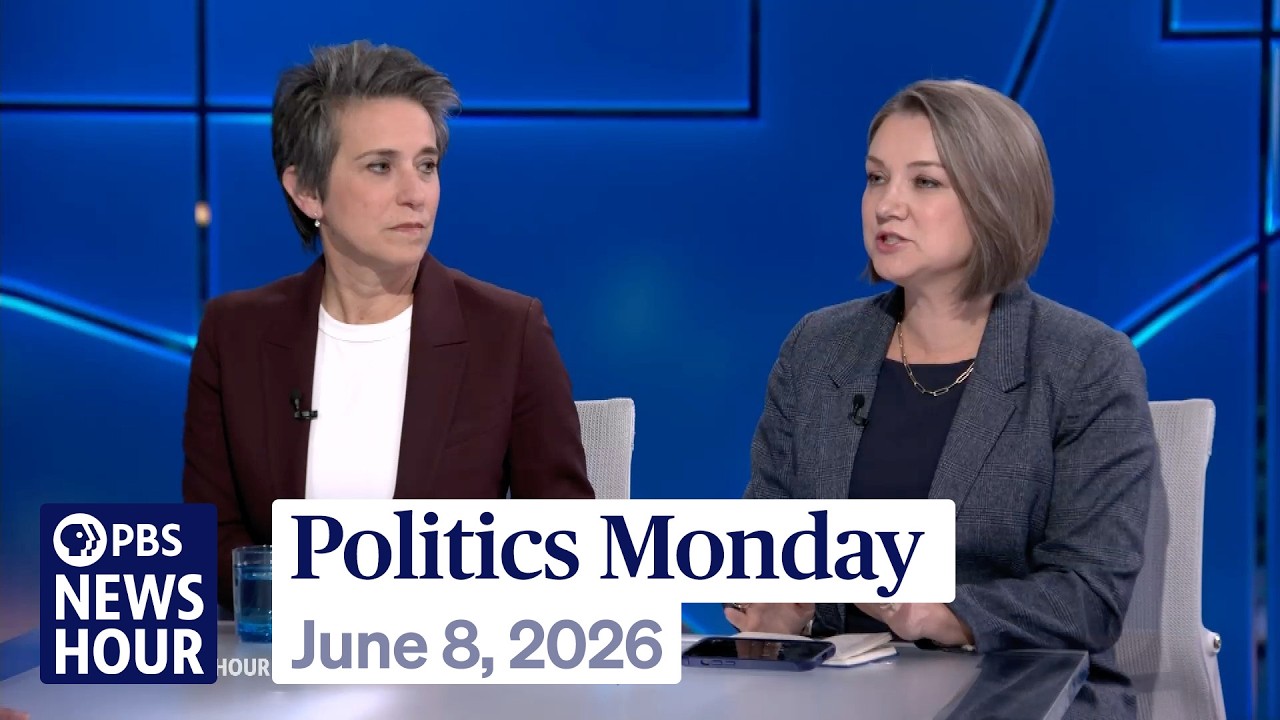
Shadowing practice: Tamara Keith and Amy Walter on Trump’s walkout from NBC interview
 Listen to the line, then say it out loud
Full transcript
- President Trump walks out under tough questioning from NBC.0:00
- Democrats face character questions ahead of a battleground Senate race.0:04
- And President Trump's influence is once again on the ballot in South Carolina.0:08
- Here on Pack It All is our politics Monday duo.0:12
- That's Amy Walter of The Cook Political Report with Amy Walter and Tamara Keith of NPR.0:15
- Great to see you both.0:20
- Good to be here.0:21
- Let's start with this interview that's getting a lot of attention.0:21
- I think it's fair to say Trump officials proudly talk about how accessible this president is to the press.0:23
- We know he takes a lot of questions on the fly in the Oval Office before leaving from the South Lawn, and even on very brief phone calls from reporters0:29
- all the time where he ends the conversation when he wants to.0:38
- He rarely sits down for extended rigorous one -on -one interviews, like the one with Kristen Welker on NBC's Meet the Press.0:41
Show all 108 lines Show fewer lines
- As we played earlier, he got very frustrated, Tam, under questioning about his anti -uptanization fund and about rigged election claims.0:49
- She was asking for evidence about what stood out to you about how angry the president got in response.0:57
- So much of the questions that he takes, as you described, the calls, all of that, is on his terms.1:03
- He's answering the questions that he wants, and when he gets a question that he doesn't like, he very frequently attacks the journalist, most especially female journalists, and he attacks1:11
- them in very personal terms.1:23
- You saw at various points during this interview him criticizing going after Kristen Welker and her questioning and her professionalism.1:25
- She stood up for herself, but this, at the end, as he's walking out, he was being pressed on this soft spot for him, which is the 2020 election and1:32
- his whole idea that the election was stolen and the election rigging and all of the things that he's been talking about for all of these years.1:47
- Based on his ideas, we should underscore here, right?1:53
- Yes, and that is why it is central to his identity, and it continues to be something where he doesn't have a good answer to the question of where's the1:56
- evidence.2:05
- Amy, how did you look at this?2:06
- And also this larger argument where the White House is always saying he's so available, he's very accessible to the press.2:07
- Right.2:13
- Well, listen, if you said why do you think the president chose to go on to a major platform, a Sunday show, I would say, well, probably because we're in2:13
- a war in Iran, although which he calls not really a war, but there's that.2:24
- And voters are very upset, number one, about the actions being taken in Iraq and the repercussions of it, namely higher inflation, gas prices, and that here's an opportunity for2:29
- the president to explain his thinking.2:40
- Where are we going in Iran?2:43
- What's the timeline to give some clarity to that?2:44
- And to also empathize with Americans who are saying, yeah, but my gas price went up, inflation is still high, they're in a farm state, fertilizer is too expensive.2:47
- That was a great opportunity to do that.2:57
- He provided none of that in this interview.2:59
- So really, I think he uses it to Tam's point as an opportunity for him to say what he wants to say, be on the record for the issues that3:03
- matter to him.3:11
- I do think it's more, though, than just obsessing about 2020.3:13
- That becomes problematic.3:16
- And Lisa obviously did a whole piece on this before we came on of really undermining the integrity of elections and the idea that as we go into 2026 election3:18
- time, the president's numbers aren't looking particularly strong.3:29
- The difficulty that Republicans are going to have to hold on to both houses in this upcoming election.3:34
- Undermining this as a rigged election is only going to further the frustration division that we have in this country about how our elections are handled and what it means3:41
- to actually have a free and fair election.3:57
- That Americans can agree whether they won or lost was actually valid.3:59
- Well, I know you've both been following the lead up to the primary elections in Maine tomorrow very closely.4:05
- Fair to say, barring rather any kind of extraordinary upset.4:11
- Graham Platner is likely to win the Democratic nomination.4:14
- Susan Collins is likely to win the Republican nomination.4:18
- Of course, there's a number of scandals around Platner that have only grown in recent weeks from this list, I have to say, from the Nazi tattoo to sexting while4:21
- married to ex -girlfriend's alleging violence.4:29
- Platner denies any violence, we should say, but on everything else he says he's transformed.4:31
- And this is how one of his supporters actually sees it.4:36
- Take a listen.4:38
- It's refreshing to have someone actually own up to stuff that they've done and say, yeah, that wasn't such a great idea.4:40
- I'm working to be a better person.4:48
- Why?4:51
- Because we all need to do.4:52
- We all have for us.4:54
- It's not a perfect rule.4:55
- So, Tamp, not for Republicans, because I think President Trump has moved the bar so far.4:58
- Before Democrats, this sort of stuff would have been disqualifying not long ago.5:02
- What's changed?5:07
- I think that if you talk to a lot of Democrats, they would say Susan Collins.5:09
- They really see Maine as a solid pickup opportunity.5:15
- And any chance that there was for Democrats to put forward a different candidate and establishment Democrats absolutely did want to put forward a different candidate, Governor Janet Mills, who5:21
- was seen as a strong recruit by Chuck Schumer and the Senate Democrats, by the time she got into that race, Graham Platner already had huge momentum.5:33
- He was like riding a wave and she's there paddling and she can't, she just can't catch it.5:46
- It was too late by the time she got in.5:50
- And so now at this point, Democrats have the front runner that they have.5:52
- And I think that there are lots of nuances here.5:58
- And a Democratic primary is also different than a general election.6:03
- And I think that we really will see a test not just in Maine, but also in Texas, where Ken Paxton, the Republican nominee in the Senate race, all of6:08
- his dirty laundry was aired in that primary and he won anyway.6:18
- And so, I think there is a question of whether primary electorates are different than general electorates or whether we're in a new era where the sort of scandals that6:22
- would have taken down a politician don't matter anymore.6:31
- And by the time some of those first Reddit posts came out, Graham Platner had already built and established this sort of grassroots following.6:34
- I was actually up in Maine the day after those first Reddit posts were revealed and sitting at an event, someone comes up to introduce Graham Platner and said, well,6:43
- we all know this is probably the Democrats in Washington who leaked this.6:56
- So the lack of faith and trust in the establishment, whether it is the candidates that they pick in Maine establishment or whether it's the quote unquote establishment in Washington7:01
- and the lack of faith too in how rumors like this get into the mainstream media also important.7:13
- But I think Tam's point about the primary is also critical.7:22
- I don't think Graham Platner is losing support from Democrats.7:25
- This is a blue state.7:29
- So, theoretically, you only need to win Democrats to win.7:30
- But this is where Susan Collins comes in.7:33
- If you look at her success over the years, it's not because she is winning Republicans, more Republicans, it's that people who voted for Joe Biden in 2020 crossed over7:35
- and voted for Susan Collins.7:47
- And the number one group to do this were women.7:49
- She won women by three points, Joe Biden won women in one woman in that state by more than 23 points.7:52
- If Graham Platner is going to win in Maine, he's got to win women who crossed over to vote for Susan Collins.7:58
- We're not going to find out whether he can do that tomorrow night.8:06
- Let me ask you too about South Carolina, because their gubernatorial primary, the Republican primary is also tomorrow.8:10
- From Louisiana to Texas Amy, as you have seen, we've seen President Trump's influence and being able to oust incumbents for his pick to make it ahead.8:16
- In South Carolina, he's pushing for Lieutenant Governor Pam Yvette.8:24
- How do you look at this?8:28
- What's going to happen here?8:29
- I think she's definitely a frontrunner in this, but these are also South Carolina and many of these southern states have runoffs.8:29
- And so getting that nod is really important.8:38
- Where the president has yet to weigh in is in Georgia, which has a, actually next week, has a runoff in the Senate race there.8:40
- I think that is also notable.8:48
- Yeah.8:51
- And I will just say in South Carolina, a governor's race is different than a Senate race or a congressional race.8:51
- And so I am certainly watching whether President Trump's influence is as strong when you're looking at a state race versus a federal race that has federal implications for how8:58
- he's able to govern.9:11
- Tamara Keith, Amy Walter.9:13
- Thank you both very much.9:15
- You're welcome.9:16
American Accent Practice on a B2 PBS NewsHour Politics Discussion
This clip is a Politics Monday segment from PBS NewsHour: an anchor introduces the story of President Trump walking out of an NBC interview, then hands off to two regular analysts, Amy Walter and Tamara Keith, who unpack it live. It runs at a measured pace, about 179 words per minute, and sits at B2, so the sentences are complex but the delivery is not rushed. The accent throughout is American, and because the segment moves between an anchor and two analysts trading opinions, it also works well as english conversation practice, not just as a solo listening exercise.
The vocabulary sits above small talk. Words like oust, alleging, battleground and grassroots turn up as the panel widens from the interview itself into the Senate race behind it, so this is a good pick if you want speaking practice that pushes you toward formal, analytical English rather than tourist phrases.
The Language of This Politics Monday Exchange: English Speaking Practice for News Vocabulary
The opening exchange has a formal, hedged register that is worth noticing before you try to repeat it.
- "President Trump walks out under tough questioning from NBC." is the anchor's lead sentence: short, with even stress on each word, useful for practicing clean sentence stress on a news headline.
- Tamara Keith opens her turn with a hedge: "I think it's fair to say Trump officials proudly talk about how accessible this president is to the press." Practicing the rise and fall on "I think it's fair to say" is real pronunciation work, since the hedge softens the claim before the harder opinion lands.
- Amy Walter answers with "So much of the questions that he takes, as you described, the calls, all of that, is on his terms." Three short items are stacked before the main clause; match her pacing through the list, then the drop in pitch on the closing words.
How to Shadow This PBS NewsHour Segment: A Step by Step English Shadowing Practice
Work the clip in order rather than jumping around. In a panel format each answer builds on the question before it, so the sequence carries meaning.
- Start with the anchor's line, "President Trump walks out under tough questioning from NBC." Shadow this line on its own until the stress on "tough questioning" feels automatic.
- Move to Tamara Keith's sentence and slow down the opening hedge, "I think it's fair to say", before you attempt the full line at speed.
- Take Amy Walter's line next and shadow this line in three chunks, matching her listing rhythm, then say it straight through without a pause.
- Once each line is solid on its own, play the anchor's line and both analysts' lines back to back. At 179 words per minute the run together is fast enough to show whether you actually improved your english accent on the parts, or only recognized them.