Shadowing practice: How the hometown humiliation of Putin marks a turning point for Ukraine | DW News
 Listen to the line, then say it out loud
Full transcript
- Russia's war on Ukraine is escalating again.0:00
- Waves of missiles, drone strikes and increasingly bold Ukrainian attacks deep inside Russian territory.0:03
- At a major international economic forum in St.0:11
- Petersburg, Vladimir Putin's hometown, the war suddenly came into full view.0:14
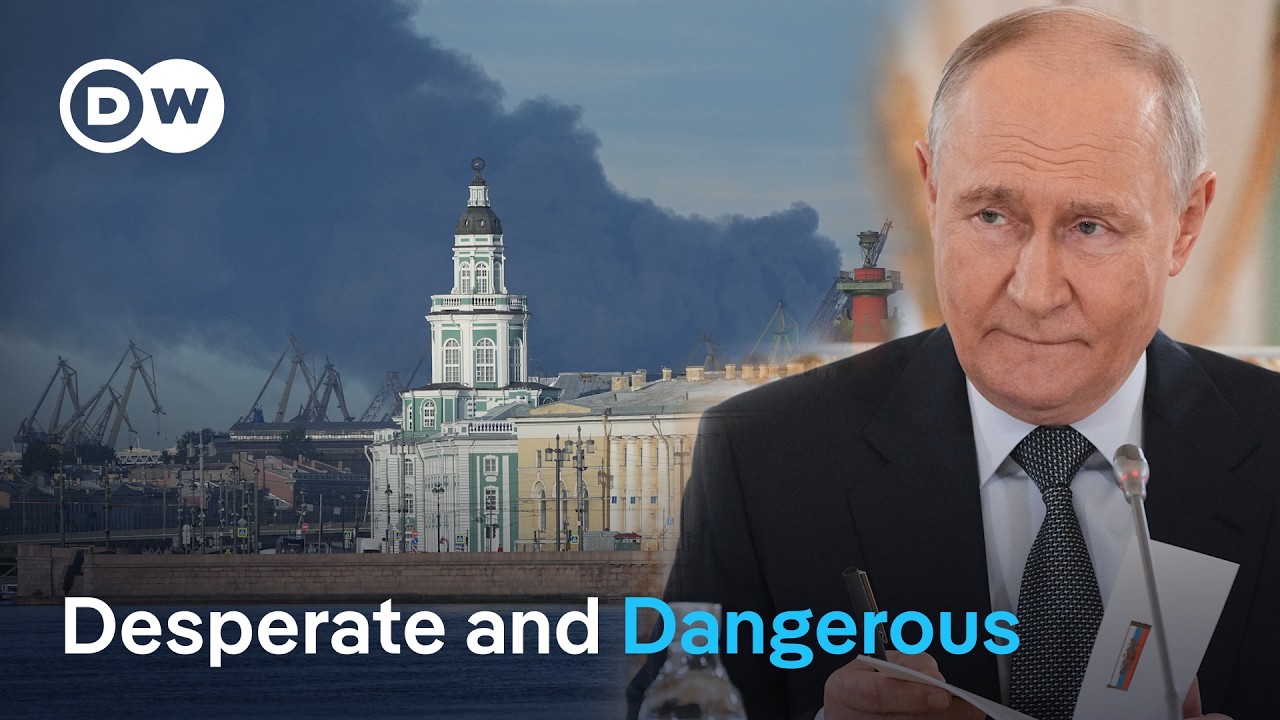
- You see this black smoke pouring into the sky?0:19
- It's a pretty humiliating moment.0:23
- That's Tim Willisie -Wilsey, professor of war studies at King's College in London.0:25
- And a former diplomat.0:29
- He's helped me break down where the war stands and what these dramatic images mean.0:31
- He says that they may point to a deeper shift.0:37
- I think there is slight evidence that Putin is rattled.0:41
- Putin is bothered about how it's going.0:46
Show all 156 lines Show fewer lines
- So is Ukraine gaining the upper hand?0:49
- And are Russia's escalating counterattacks a sign of strength or desperation?0:51
- Cut this moment shape how this war ends.0:57
- I think it is a critical moment, but I think it's one of several critical moments that have been over the four years.1:00
- It's very difficult to predict whether this is the critical moment.1:06
- I think what's different here is, I think there is slight evidence that Putin is rattled.1:10
- Putin is bothered about how it's going.1:19
- And indeed so he should be.1:21
- I mean it went very well for him over the last winter.1:22
- I mean Kiev had a terrible winter of attacks and the attacks on its electricity.1:25
- You know, and a lot of people were freezing in their flats and it was a pretty dire situation.1:31
- But really ever since the spring, ever since April, things have very much gone Ukraine's way.1:36
- And I think Putin actually showed a very rare moment of weakness when he had to go to Donald Trump to ask Zelensky not to attack the parade for the1:41
- Great Patriotic War.1:53
- If you're a dictator, and let's call Putin a dictator, if you're a dictator, the one thing you cannot afford to show is weakness for your domestic audience.1:54
- And I think to his sort of the hard men of the FSB, the people who support him, would have seen that moment and would have regarded as pretty humiliating.2:03
- Zelensky actually wrote saying, you know, basically, I permit you to have a parade.2:13
- It doesn't get a lot worse than that.2:19
- I think things have turned in Ukraine's favour.2:21
- It doesn't mean that it's going to remain that way.2:24
- It doesn't remain mean that Ukraine are going to win this war, whatever that means.2:26
- But I think it is a critical moment.2:30
- What does it mean that Ukraine can strike Putin's hometown at the very moment he's trying to project strength and global support?2:33
- Of course, it's not just that it was Putin's hometown.2:40
- It's this big conference going on in which actually there are United States representatives there as well.2:42
- I think people from a very large number of countries, almost 100 countries, I think, are there.2:48
- So this is a big showcase to Putin, to show the world that he has got the support of so many countries and he's widely admired, which he is in2:53
- many parts of the global south.3:04
- And then suddenly, of course, you hit an oil refinery within visual distance of the conference from.3:08
- And you see this black smoke pouring into the sky.3:14
- It's a pretty humiliating moment.3:18
- Beyond symbolism, Ukraine is now striking deep inside Russia using home -built weapons, which gives complete autonomy on what targets they can hit.3:20
- It's not just drones as well.3:30
- Some of these are long -range missiles.3:31
- And it is remarkable, really, that Britain and France allowed a particular long -range missile to be used with the French called Scalp and the British called Storm Shadow.3:33
- The Germans wavered over Taurus and I'm still not convinced that any Taurus have actually been delivered to Ukraine.3:46
- In spite of Friedrich Merz sort of sounding quite positive before he was elected.3:56
- So what have the Erech Ukrainians done?4:01
- They have gone and manufactured their own.4:03
- And this F .P.4:04
- range of missiles they have developed, a lot of them, which are sort of semi -copies of Western and actually Soviet, stroke Russian missiles as well, has been one of4:06
- many remarkable technical achievements.4:21
- So they can now strike over a thousand miles.4:23
- And I think one of their missiles has been designed to do over 2 ,000 miles.4:26
- So in April they did, I think, 21 strikes against the oil infrastructure, some in the Baltic, some in the Black Sea and some beyond the Urals.4:31
- And I think eight particular refineries were hit.4:42
- This is pretty impressive stuff by the Ukrainians.4:47
- The other interesting aspect to this, I think, is that I think in the past Zelensky has been very anxious to do something which might spark the annoyance of Donald4:51
- Trump.5:02
- Now with Trump so busy, so focused on Iran and the Gulf, and getting himself out of the real fix that the United States is in in the Gulf, he's5:03
- not focusing so much on Russia and Ukraine.5:15
- So I think Zelensky's got more freedom now.5:18
- Only a few months ago that attack on St.5:22
- Petersburg, I think would have drawn a condemnation from Trump.5:25
- But at the same time, Russia has stepped up its strikes on Ukraine, causing significant loss of life and great amounts of damage to infrastructure.5:29
- So are we looking at a change in strategy or is something more political taking place?5:38
- I read it as two things.5:44
- I think there is a hint of desperation in there, by the way.5:45
- But I also think it's trying to grab the attention of Washington, and it's trying to terrify both the Ukrainians and the Europeans.5:47
- I don't think it's going to terrify the Ukrainians.5:57
- They've been through this stuff for four years.5:59
- But to use the Eurasianic missile, albeit with no warhead apparently, but here is a nuclear capable missile capable of great speed, it's a terror weapon really.6:02
- That's not military, that's message sending.6:20
- That's sending a message to Ukraine that we're serious about this.6:22
- To Europe, you'd better not help Ukraine.6:27
- And to the United States, please, could you reconnect with us and get Wittkopf over here?6:30
- Because in a sense, the biggest threat to Zelensky and Ukraine is another burst of Trump diplomacy, which so nearly, if you remember, over the winter, gave Putin everything he6:35
- wanted, which was the Donbas, even the parts of the Donbas that he has not even taken yet.6:51
- So these I think are the motivations behind Putin at the moment.6:57
- Now we're often looking for a turning point in this war.7:02
- So how much pressure is the Russian president really under?7:06
- Putin is still currently dominant.7:09
- All I'm suggesting is he's shown a couple of cracks.7:12
- Now, what are those?7:14
- So, yeah, going badly in the Donbas.7:16
- Then there's the very interesting reporting from the Institute of Study of War of the Ukrainian success towards the land routes to Crimea and to the Sea of Azov, which7:19
- is a very, very interesting new development.7:30
- There was the loss of his ally, Prime Minister Orban of Hungary, to an election.7:33
- Trump distracted and we've talked about and the attacks on the oil infrastructure.7:40
- So, you know, several things going wrong.7:44
- Look at some of the other things.7:46
- Rushing to China just after Trump visited to find out what has been discussed.7:48
- Sort of thing, you know, is there anything I should be worried about there?7:53
- The talk about another offensive in Belarus, the exercises with the Belarusian army, including nuclear exercises.7:57
- I mean, a lot of this is message -sending.8:09
- Again, it's just trying to alarm everybody.8:11
- But the interesting thing when you talk about Putin's position is how is then that perceived by the hard men in the Kremlin who look at him and say, hang8:14
- on, this guy is showing signs of weakness.8:22
- And I think you're also aware there have been a few signs of a few comments made in Moscow, which only a few years ago would have resulted in those8:25
- people being imprisoned.8:34
- I think the Pravda corresponded in Moscow started speculating whether they might even call off the Red Square parade.8:36
- I think the only thing I would say is, you know, we need to be careful what we wish for.8:42
- If there were to be a replacement for Putin, I don't think it's going to be some nice, cuddly liberal who's going to get on with, you know, Macron and8:47
- Merz and Stammer.8:56
- It's not going to be that sort of person.8:58
- So, you know, we need to be a little bit cautious about this.9:00
- We're hearing more talk of negotiations, possible meetings, direct engagement.9:04
- But is that meaningful or is it just positioning?9:09
- Well, Zelensky's messaging of yesterday, I think, is a grandstanding.9:12
- I don't think it's serious at all.9:18
- He says, you know, I'm prepared to meet you.9:19
- But then he actually rather mocks Putin and says, you know, we've even visited your hometown, you know, a thousand miles from here.9:22
- So, you know, reference, I think, to the strike on St.9:29
- Petersburg.9:31
- So I don't think Zelensky's thing was serious.9:32
- I don't really think Putin's was either.9:34
- Because if you remember, he talked about Gerhard Schroeder as an intermediary.9:38
- Well, you know, that's going to be acceptable to absolutely nobody.9:42
- So why is he talking about mediation?9:47
- Again, I think he's trying to recapture the attention of Donald Trump, which, you know, which he hasn't yet.9:50
- So I'm not convinced about mediation on either side.10:00
- So realistically, are we anywhere close to Putin and Zelensky sitting down and talking?10:03
- I think the chances of a face -to -face meeting are absolutely minimal.10:10
- I know in Europe there is talk about, you know, whether or not there should be negotiations sponsored by Europe.10:14
- But I think even those are at a very, very embryonic stage.10:22
- What I do think has been very interesting in the last day, though, the last few days, is there's been a...10:26
- And I don't know whether this is in the UK only, but the Russian ambassador in the UK gave an interview in which he pretty much directly threatened NATO countries10:31
- which support Ukraine.10:42
- Curiously enough, he mentioned UK, Denmark and Canada, which seemed like a rather random selection of countries.10:44
- But I think at one point he even said, you know, even we know where your addresses are.10:51
- It seemed like a direct threat.10:56
- And I think this is actually, I think this is part of the policy, which is, you know, to ramp up the pressure on European countries.10:57
- Let's step back for a moment and consider what we've discussed.11:05
- And this is where we'd like to hear your thoughts.11:09
- Where does this war actually stand right now?11:12
- I think what's happened is Ukraine has turned the tables on Russia this spring.11:15
- And a lot of it actually is this extraordinary kill zone they have created, what they call the kill zone, this 40 -kilometre deep zone, in which Ukraine now tries11:21
- to have virtually no troops at all, just using drones, coordinated, I think, to an extent by AI.11:32
- They've got this Delta management system and this SkyMap system of all sorts of sensors to...11:42
- And so you've now got an extraordinary thing, almost like a computer game happening.11:48
- Now, all the advantages now therefore lies with the defender.11:53
- And Russia is trying to take territory, so it's pouring men into that kill zone and losing them in vast quantities.11:57
- So suddenly, what we used to say, which was why Russia would ultimately win, is they've got more people.12:05
- Suddenly, people is not the issue for Ukraine anymore.12:12
- They've taken that out of the equation.12:15
- They have made this into the most modern, technological, partly AI -driven warfare, which is winning.12:17
- Now, the problem is, all the advantages with the defence, what happens if Ukraine then tries to retake the bits of the Donbas that Russia has taken?12:26
- Then I think you're in a really different situation.12:40
- So I can see this is a very successful defensive war, but I don't think it wins them back the Donbas or the Crimea, unless, of course, the Russian army12:43
- mutinies or the Russian government remove Putin.12:53
- So while Ukraine may have shifted the dynamics on the battlefield, the bigger question still remains, whether that's enough to change the outcome of the war.12:57
- For now, Russia still holds territory, and as we've heard, turning this defensive advantage into outright victory is far from guaranteed.13:05
- I'm Pablo Folialias.13:15
- See you again soon.13:16
English Shadowing Practice on a B2 DW News Interview About Putin's St. Petersburg Moment
This clip is english shadowing practice built on a real DW News interview, not a scripted lesson. Two voices carry it: a news host and a professor of war studies at King's College London, working through what the black smoke over St. Petersburg during a Putin economic forum means for the war in Ukraine. At B2 and 171 words per minute, a pace faster than 35% of the catalogue, this suits a learner who already follows connected news speech and wants to keep pace with an analyst thinking aloud, not reading from cue cards.
The interview shape is what makes it good for daily english conversation practice: the host asks, the professor answers, and you get real turn taking instead of one flat script. Across 156 lines the register stays formal but conversational, the kind of speaking practice that carries into real interviews, panel discussions or any moment you have to follow an expert's live reasoning rather than a rehearsed statement.
The Language in This Interview: Hedged Claims and a Rattled Putin
Three moments in the opening stretch reward close listening before you try to speak them back.
- "It's a pretty humiliating moment." A short reaction line, but the stress falls on "pretty humiliating", not on "moment". Shadow this line a few times to get the downbeat on the adjective right before you move on.
- "I think there is slight evidence that Putin is rattled." This exact hedge returns twice in the transcript, once from the professor and once echoed by the host. It is a stacked hedge, "I think" plus "slight evidence", the way analysts soften a strong claim. Practising it out loud is real work on how to pronounce english words in a run of unstressed function words without flattening the sentence.
- "I mean it went very well for him over the last winter." "I mean" opens the line as a spoken discourse marker, not a filler to cut. Say it with the same rise and fall as the recording and it starts to sound like a person thinking, not a list being read.
How to Work Through Lines 1 to 33 of This DW News Clip
Work the opening third of the interview in order rather than jumping around; the host's setup and the professor's first answers build on each other.
- Start with lines 1 to 4, the host's scene setting. These are short, declarative sentences, good for warming up before the professor's longer turns arrive.
- Shadow line 6, "It's a pretty humiliating moment," five times in a row until the stress pattern is automatic, then move on.
- Take lines 11 and 18 together since they repeat almost word for word. Say line 11 once, then line 18, and listen for how close your two attempts sound to each other, not just to the recording.
- Slow down for line 21, "I mean it went very well for him over the last winter," and mark where the voice speeds up after "I mean". This is where the clip's pace stops feeling flat and starts feeling like real speech.
- Finish the block at line 33 and check your recall of the whole stretch before continuing further into the transcript. This kind of english shadowing practice for a b2 speaker works best in short repeated passes rather than one long read through, and it is free, in your browser, with no install.