Shadowing practice: How a Single Swedish Submarine Defeated the US Navy
 Listen to the line, then say it out loud
Full transcript
- This episode of rail engineering is brought to you by Brilliant, a problem -solving website that teaches you to think like an engineer.0:00
- The United States military has the strongest and most diverse Navy in the world.0:07
- The US military's fleet of aircraft carriers is so large it makes the US Navy the second largest Air Force in the world, second only to the actual US Air0:11
- Force.0:19
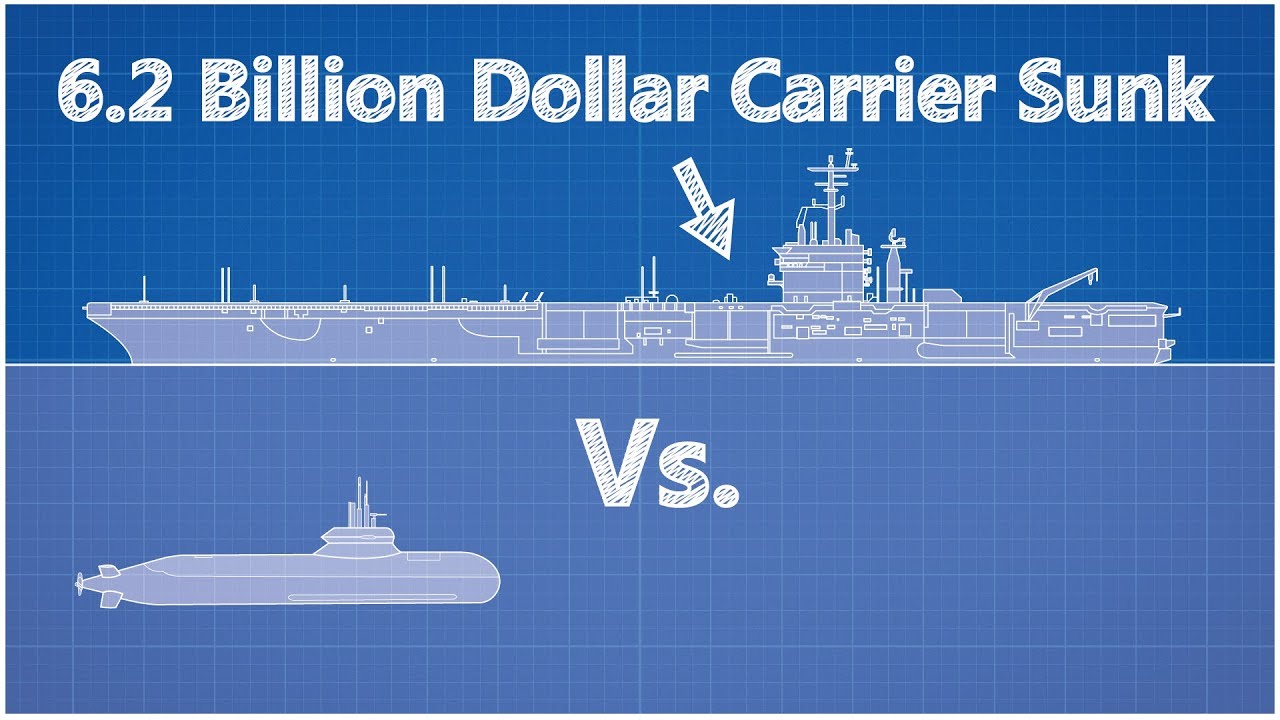
- A single Namitz -class aircraft carrier like the USS Ronald Reagan, a $6 .2 billion nuclear -powered ship, can carry twice the aircraft as any other foreign carrier, which makes0:20
- it even more shocking that it was sunk by a single diesel -powered Swedish submarine during war games in 2005.0:31
- A single submarine that costs the same as a single F -35 at $100 million managed to sneak by an entire carrier task force with anti -submarine defenses to enter0:37
- the red zone and score multiple torpedo hits on the US Ronald Reagan, sinking it virtually, before shrinking back into the vast ocean undetected.0:47
- This was just one of many exercises where the Swedish -Gotland -class submarine proved too stealthy for the world's strongest Navy.0:55
- The new submarine proved so threatening that the US military leased the Swedish sub for an additional year to develop strategies to counter the silent threat.1:02
- So what set the Gotland apart from other subs?1:09
- Submarine's primary instrument to detect enemy subs is sonar.1:12
Show all 79 lines Show fewer lines
- Sonar is essentially a finely -tuned ear that works like a whale's or dolphin's echolocation to create a 3D map of the ocean around it.1:15
- There is active sonar where the submarine will send out a sound pulse called a ping and listen for the reflections.1:22
- But in warfare, this isn't a sound strategy, as the ping is detected by enemies to give your exact location.1:28
- So passive sonar is used where no ping is emitted and instead you simply listen.1:34
- These electronic ears are so accurate that the nationality of submarines can be determined based on the operating frequency of the alternating current used in its power systems.1:38
- And the 60 Hz alternating current of a US sub could be differentiated from the 50 Hz of European subs if the transformers and other electronics were not adequately insulated1:47
- from the hull.1:56
- The Swedes managed to create a submarine so silent that it was practically undetectable by passive sonar.1:57
- So how did they do this at such a low cost?2:03
- The Gotland was the first submarine in the world to use a Stirling engine as its power generator.2:06
- Stirling engines are not a new concept, with the first being created and patented by Robert Stirling in 1816.2:11
- Inspired by a series of high pressure steam boiler explosions at the beginning of the industrial revolution, Stirling wanted to create a safer engine that did not require such high2:17
- pressures.2:26
- I can't be arsed trying to animate this old drawing so let's go for something simpler.2:27
- He did this by creating a closed cylinder containing a fixed mass of gas permanently sealed within.2:31
- Here one side of the piston cylinder has a large buffer space which allows for a relatively constant pressure on this side of the piston.2:37
- While the other side fluctuates in pressure due to alternating heating cycles.2:43
- When heat is applied to the outside of the cylinder, the pressure increases causing the piston to move until the pressure equalizes.2:48
- Now if we cool the outside of the cylinder with a heat exchanger the pressure will drop and once again the piston will move.2:54
- This is our basic pressure cycle to create mechanical work.3:00
- But this is an insanely inefficient system as most of the energy we put into the system as heat is lost during the cooling cycle.3:03
- Not to the gas but the actual cylinder wall which provides no mechanical work.3:10
- Robert Stirling solved this by adding a displacer piston which can drive the gas from one end of the cylinder to the other, allowing this end to be permanently hot3:15
- and the other to be permanently cold.3:22
- So the cylinder wall is no longer experiencing a temperature cycle.3:25
- The pressure cycle here works slightly differently.3:28
- First the air on the hot end expands and causes the displacer to move into contact with the power piston, displacing more air from the cold end to be heated3:30
- and expanded, allowing work to be done on the power piston.3:38
- The air on the hot end now has nowhere to go and so is driven to the cold end where it is cooled and contracts causing work to be done3:41
- once again on the power piston.3:47
- This is our new pressure cycle.3:49
- The efficiency of this system can be increased further by placing what is essentially a heat battery in the tubes between the hot and cold cylinders.3:50
- This conserves a huge amount of heat that would otherwise be wasted during the cooling cycle and gives the heat back to the air as it travels back through.3:57
- Robert Stirling dubbed this the regenerator.4:04
- Now we have the foundations of a useful engine.4:07
- By incorporating a coolant system and a heating chamber, we create a larger temperature differential to drive the engine and the efficiency can be further increased by increasing the number4:10
- of tubes connecting the hot and cold spaces along with the number of regenerators and adding fins to increase the surface area of these tubes to allow for heat transfer.4:18
- Did I say simplified?4:27
- Sorry, I meant easier to read.4:29
- Maybe I like the misery.4:31
- Stirling engines ultimately fell into obscurity as stronger steel became available to make steam engine boilers safer, but I've seen a resurgence in recent decades with the Gotland being the4:33
- most famous implementation.4:42
- The Gotland uses two Stirling engines that use diesel and liquid oxygen to provide heat, which in turn runs at 75 kW generators.4:44
- These generators can run an electric motor directly or charge batteries that can provide a huge boost in speed when needed.4:51
- All the while the exhaust is compressed and stored on board, allowing the sub to stay submerged for up to two weeks, vastly longer than any other diesel powered submarine.4:58
- So why is it so silent compared to other submarines?5:07
- It doesn't require much explanation as to why an internal combustion engine using tiny controlled explosions for power tends to lead to some noise.5:10
- While the multi -billion dollar nuclear powered submarines need to pump huge volumes of coolant to their reactors to prevent a meltdown, causing enough noise to be detectable by passive5:18
- sonar within a certain range.5:27
- On top of this, recently declassified intelligence suggests that Russian submarines are using these instruments to detect the faint trail of radiation left in the wake of these nuclear powered5:28
- submarines, giving the Swedish submarine another way of avoiding detection.5:38
- This is a fascinating application of the laws of thermodynamics.5:42
- Understanding and applying the laws of science is the closest to a real life superpower in this world, so why not unlock your superpower of understanding the universe by taking5:45
- this course on astronomy on Brilliant?5:54
- This course will take you from learning about the tools astrophysicists use to observe the universe through to the calculations that will allow you to peer into the future of5:56
- the universe.6:04
- Brilliant is a problem solving website that teaches you to think like an engineer.6:05
- You can dive in and start learning about a huge range of topics starting from basic physics and working your way up to more complicated topics.6:09
- To support real engineering and learn more about Brilliant, go to brilliant .org forward slash real engineering and sign up for free.6:16
- The first 73 people to sign up with this link will get 20 % off their annual premium subscription.6:22
- I get to learn and solve these kinds of problems for a living and I love it.6:28
- It gives me that warm glowy feeling inside when I finally conquer a difficult problem.6:32
- Actively challenging your brain on a daily basis and getting that endorphin rush of a job well done is great for your mental health.6:36
- Brilliant even have an app where you can challenge yourself on the go.6:43
- As always, thank you to my patrons and thank you for watching.6:46
- If you'd like to join the real engineering community, I've recently set up a subreddit where we discuss everything engineering related and more.6:48
- The link for that is in the description.6:56
English listening practice with a fast, C1 level submarine warfare narration
This clip offers english listening practice built around the opening of a Real Engineering video about the Swedish Gotland class submarine that sank a US aircraft carrier during war games in 2005. The narrator, who speaks with an Irish accent, walks through the size of the United States Navy and its Nimitz class carriers before turning to how sonar actually works. The pace sits at 213 words per minute, faster than 72 percent of the catalogue, so there is little room to drift while the narrator moves from the Navy's fleet size to submarine physics.
The content is rated C1, and the full clip runs to 79 lines of dense, fact packed narration rather than casual chat. That mix, a quick pace and technical subject matter, makes this a clip for a learner who already handles everyday conversation and wants to work at speed on precise, unhurried delivery.
How to pronounce english words like sonar and echolocation in this narration
Working out how to pronounce english words like sonar, thermodynamics and echolocation matters here, because this narration leans on exact technical terms rather than everyday phrasing. Three lines show what you are up against.
- "Submarine's primary instrument to detect enemy subs is sonar." A short subject and complement sentence that puts full weight on the word sonar at the very end, a good place to isolate stress before the term appears again and again later in the clip.
- "So passive sonar is used where no ping is emitted and instead you simply listen." Two passive verbs, is used and is emitted, sit close together, which is useful for practising how English carries stress through a passive clause without slowing down.
- "The Swedes managed to create a submarine so silent that it was practically undetectable by passive sonar." A so that construction stretched across a long sentence, ending on the multi syllable word undetectable, which needs its own careful stress before you can say it at pace.
Shadowing english speaking practice for this C1 submarine narration
Shadowing english speaking practice on this clip works best in order, since the ideas build on each other from the Navy's size to the physics of sonar.
- Start with line 2, "The United States military has the strongest and most diverse Navy in the world." Shadow it a few times to get used to the narrator's Irish delivery before the pace builds.
- Move to "Submarine's primary instrument to detect enemy subs is sonar." and repeat it until sonar lands cleanly, since the word recurs through the rest of the clip.
- Take "So passive sonar is used where no ping is emitted and instead you simply listen." slowly first, then match the narrator's speed to fit both passive verbs into one breath.
- Finish on "The Swedes managed to create a submarine so silent that it was practically undetectable by passive sonar." and shadow it until undetectable stops breaking your rhythm.