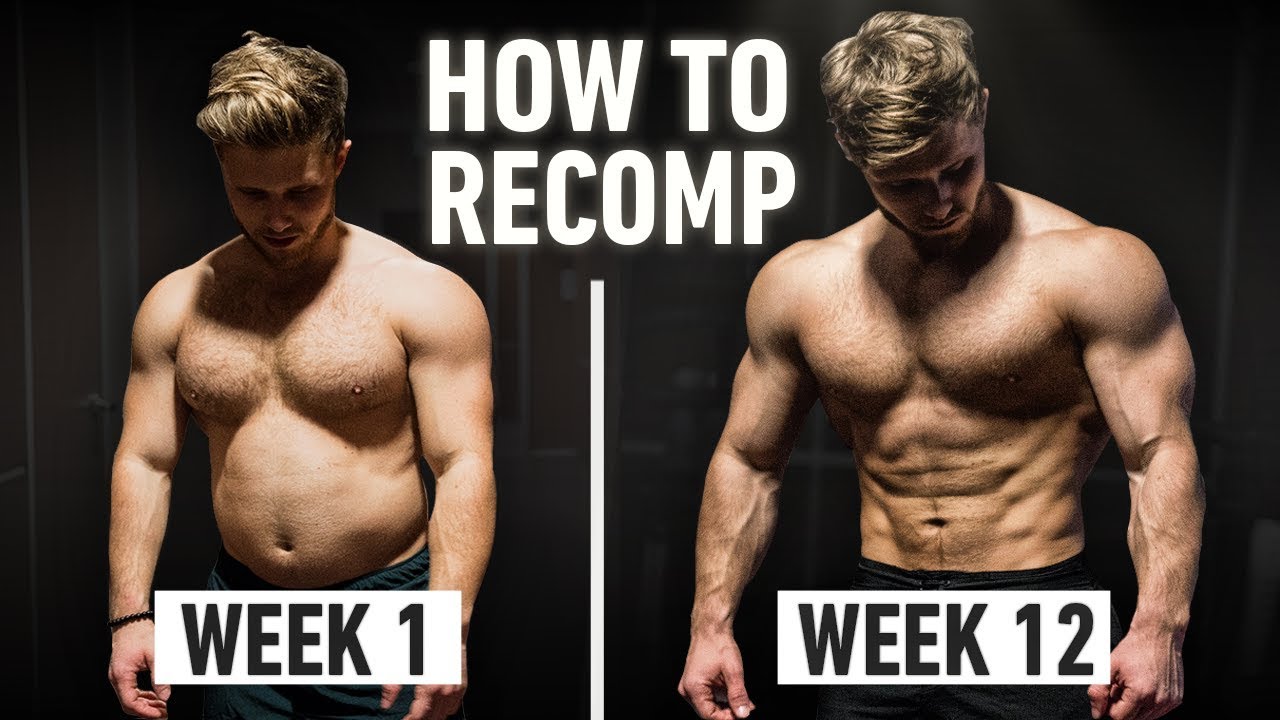
Практика английского по видео: How To Build Muscle And Lose Fat At The Same Time
 Послушай фразу и повтори вслух
Фраза 1
Полный текст видео
- How can you build muscle and lose fat at the same time?0:00
- A lot of people on the internet think the answer is simple.0:03
- You can't.0:05
- If you want to build muscle, you need to do a proper bulk, and if you want to lose fat, you need to do a proper cut.0:06
- I think this idea has made its way into the mainstream from old bodybuilding lore, where it was thought that you had to be in a massive caloric surplus to0:12
- build size and then trim down for competition.0:19
- But recent scientific evidence has challenged this idea.0:21
- For example, this 2013 study from Garth and colleagues found that even when they overfed subjects by 600 extra calories per day, they actually didn't gain significantly more muscle, but0:24
- did gain over three times the fat mass.0:34
- So nearly all the extra bulk came as fat.0:37
- Now I should say I don't actually have anything against cutting and bulking.0:39
- In the right circumstances, I think it makes perfect sense.0:42
Показать все фразы (133) Свернуть
- And many of you guys know last year I ran a pretty hefty bulk myself that I called bare mode, and I still think that if you want to gain0:45
- as much muscle and strength as possible, as fast as possible, then being in a bigger caloric surplus is the way to go.0:51
- However, this quicker muscle gain will come at the expense of more fat gain as well.0:58
- And many people simply don't want that, but just accept it as an inevitability.1:03
- But it doesn't have to be that way.1:07
- In fact, it's perfectly possible to build muscle without a large surplus, or even without any surplus at all, because fat tissue and muscle tissue are separate systems.1:08
- And I've broken down the math explaining why this is possible in another video that I'll link below.1:17
- Now many people will get on board with this and say, okay, building muscle while losing fat is possible, but not really practical, because it only applies in a handful1:21
- of more limited and obscure scenarios.1:29
- But I think these scenarios aren't as limited as they seem.1:32
- And I would say body recomposition is a realistic goal, not only for some people, but nearly all people.1:35
- So let's quickly cover the situations where I think recomposition makes the most sense.1:41
- First of all, new lifters.1:44
- Newbies can build muscle and lose fat at the same time quite easily, because as a new lifter, you're the most primed for muscle growth you'll ever be.1:46
- This means that calories can be pulled from stored body fat to fuel the muscle building process with just basic progressive resistance training and a reasonable diet.1:53
- Second, because overweight individuals have very large energy reserves stored in body fat, they can eat in a caloric deficit and still have plenty of stored energy to fuel the2:02
- muscle building process.2:10
- Thirdly, detrained individuals who got jacked before, but then stopped training due to injury or other commitments, are in a similar camp to the new trainee, where owing to the2:11
- very powerful muscle memory effect, they're able to rebuild a lot of muscle very quickly, making recomposition common.2:20
- And finally, using anabolic steroids allows most people to build a lot of muscle very quickly, allowing the body to tap into fat stores to fuel muscle building.2:26
- But at this point, I would say even if recomposition were limited to these four groups, walk into any commercial gym, and most people will fall into one of these2:35
- four categories.2:43
- For example, even if you've been in the gym for several years, you might still fall under the newbie category if you haven't been training nearly hard enough or smart2:44
- enough over the years.2:52
- I'd also add a fifth category to this list, the suboptimized trainee.2:53
- This would include anyone who's been going to the gym for a while, may even count themselves as an intermediate or advanced level lifter by training age, but deep down2:57
- hasn't really been putting in their best effort with their training or nutrition.3:04
- And according to my good friend and co -author, Chris Bearcat, he sees recomposition in his lab all the time, even in more advanced trainees.3:08
- So I literally see this every single semester.3:15
- Every training study we've ever ran, I've seen body recomposition occur.3:18
- Once we really start paying attention to some of the details to a higher extent, like nutrient timing and really optimizing their macronutrient intakes, we can see recomposition with some3:22
- of the best athletes ever.3:32
- This one subject in particular, he gained 20 pounds of lean mass in 10 weeks, and he actually lost like a pound of fat mass at the same time.3:33
- So he was a basketball player, pretty well trained when it comes to resistance training.3:41
- He was able to squat 1 .75 times his body weight.3:45
- So he set the criteria for the study and he just blew up.3:49
- He basically came in the lab looking like a normal basketball player and then he looked like Phil Heath playing basketball.3:52
- So I think there's really only a tiny subset of the population that recomposition wouldn't be practical for, truly advanced trainees already with perfectly optimized training and nutrition who are3:59
- near their genetic ceiling for muscle growth.4:09
- But in my opinion, this is the obscure scenario and it only occupies a tiny sliver of the total population looking to improve their physique.4:11
- Okay, so body recomposition is not only common, but practical.4:18
- Now, how do we do it?4:22
- Let's break it down into five simple steps.4:23
- First, you need to recognize that training is the driving force of body recomposition in any scenario.4:25
- You can have the most optimal diet in the world, eat over 9 ,000 grams of protein per day, and you still won't build much new muscle without a progressive4:30
- training stimulus.4:37
- In the book, we use the analogy of a car where we can think of our training as the engine and our nutrition as the gasoline to fuel performance.4:39
- Better the fuel, the better the performance.4:46
- However, without the engine, the car simply won't move regardless of the fuel's quality.4:48
- We can also think of sleep and stress management as the oil changes entire rotations required to keep things moving.4:52
- So when it comes to training, you want to focus on progressive overload, applying effort, and using proper technique.4:58
- And once you have the fundamentals in place, fine tune your volume to fit your advancement level.5:05
- Generally speaking, 10 to 20 sets per body part per week is a good ballpark for most people and most muscles.5:09
- Next, you need to decide on a primary goal.5:15
- Even though you may want to do both at the same time, it's important to establish which is more important to you.5:18
- For example, if you're currently on the leaner side, let's say 8 to 12 % body fat as a male or 18 to 22 % as a female, then your5:23
- primary goal should probably be to build muscle.5:31
- And if you're not so lean, so somewhere between 15 to 20 plus percent as a guy or 25 to 30 plus percent as a girl, then maybe your primary5:33
- goal should be to lose fat.5:41
- Once you've decided on your primary goal, next you want to center your caloric intake around maintenance calories, the number of calories you need to eat to maintain your weight.5:43
- If your primary goal is to build muscle, you should enter a slight caloric surplus adding 5 to 25 % to your maintenance intake.5:51
- If you're leaner, less advanced and more genetically gifted for building muscle, you can get away with a bigger surplus.5:58
- If your primary goal is to lose fat, you should enter a slight caloric deficit slashing 10 to 20 % off your maintenance intake.6:04
- The more fat you have to lose, the bigger the deficit should be.6:10
- And in the book, we outline other considerations such as if you're detrained, highly advanced, skinny fat, or significantly overweight.6:13
- Next, you need to set up your macro targets, starting with protein, the most important macro for recomposition.6:20
- In the book, we recommend a sliding model for protein intake based on lean body mass.6:26
- Where the leaner you are, the closer you should be to 1 .6 grams per pound of lean body mass, and the more body fat you have, the closer you6:31
- should be to 1 .2 grams per pound lean body mass.6:38
- Using myself as an example, I currently weigh 165 pounds at about 10 % body fat.6:41
- Using our sliding model, since I'm quite lean, I should be more toward the high end of intake.6:46
- I'll pick 1 .5.6:51
- Multiplying it out, that would give me a daily protein intake of 222 .8 grams per day, so I can round that up to 225, which is what I'm eating6:53
- at the moment.7:01
- And my last full day of eating video, I explained the benefits of going higher on protein than might be required just to build muscle.7:02
- So even though you could probably get away with less, I think eating a higher intake is both safe and advised for those looking for recomb.7:08
- From here, you want to determine your fat and carb intake.7:16
- Personally, I set my fat intake at a minimum of 20 % of caloric intake and then fill in the rest with carbs.7:18
- Okay, the fifth and final step to achieving body recomposition is to pay attention to the details.7:24
- Like I mentioned earlier, this step might not be required for beginners.7:29
- They can get recomb by just following the first four steps.7:33
- But as you get more advanced, recomb gets more difficult, so it's more important to optimize your approach.7:35
- We spend a lot of time in the book laying out these optimization strategies.7:41
- I'm going to focus on a few of them here.7:44
- The first is to sleep more.7:46
- I think sleep might be the single most underrated factor when it comes to transforming your physique.7:48
- Just consider this 2018 study from Wang and colleagues.7:52
- They split 36 subjects up into two groups that both entered a caloric deficit, except one group slept one hour less five nights per week.7:55
- They were also allowed to sleep one hour extra on the weekends to catch up.8:03
- As it turns out, after eight weeks of dieting, weight loss was the same in both groups, but the group that slept well lost 83 % of their weight from8:06
- fat, whereas the sleep restricted group lost 85 % of their weight as lean mass.8:14
- That is crazy.8:19
- Now, it's worth mentioning that these subjects weren't weight training, so lifting probably would have flattened out the results a bit, but I don't think it would have been enough8:20
- to offset that enormous difference that sleep made.8:28
- The next area we can look to optimize our approach is through peri workout nutrition or the timing of nutrients around the workout.8:31
- I already discussed some of the misconceptions around this topic in my latest full day of eating video, so I'll just link that video down below.8:37
- We can also turn to supplements to optimize, but it's worth noting that there aren't any recomp supplements that just cause recomposition on their own.8:43
- However, there are a few worth mentioning that can help.8:50
- In the book, we organize our supplements list into tiers.8:53
- At the top of the list in tier one, we have protein powder, creatine, and caffeine.8:56
- Protein powder is especially important for vegan lifters, and I recommend so -called vegan whey, a blend of rice and pea protein that offers a full spectrum of amino acids9:00
- and has a high loosing content.9:09
- Whey protein can be used at any time of day to help make meeting total daily protein goals easier, and consuming a casein source before bed might have merit as9:11
- well.9:19
- Creatine is by far the most well -studied supplement on the market, and given how cheap it is and how low its risk of side effects are, it's a pretty9:19
- obvious choice to supplement three to five grams of creatine monohydrate per day, and I'll link my creatine science explained video down below if you'd like more info on that.9:26
- Caffeine rounds out tier one of our supplements shortlist for increasing strength, prolonging time to fatigue, increasing acute fat oxidation, and more.9:34
- However, unlike creatine, caffeine is susceptible to tolerance, so it might be smart to reserve it for your heaviest or most demanding training sessions, or periodically cycle off it to9:42
- resensitize yourself to the effects.9:51
- And of course, we dive into many other optimization strategies across the 15 chapters in the new nutrition guide, including sample meal plans, pre and post workout meal examples, more9:53
- supplements, cardio strategies, and a lot more.10:02
- So if you guys are looking to take your nutrition up a notch, you can save 25 % off the ultimate guide to body recomposition at the first link in10:05
- the description box below for the launch, or you can head over to jeffnipper .com, go to the nutrition plans tab, and you can find it over there.10:12
- And after launch week, so next weekend, it'll be going up to full price.10:19
- So the manual has over 140 scientific references, an exact step by step guide for setting up your calories and macros, a list of foods to focus on, and even10:23
- a full chapter on training for recomb.10:31
- It also includes customer service.10:33
- So if you guys have any issues, there's a support email that you guys can contact.10:35
- So hit up the link over here next to my head.10:38
- If you guys are interested in checking it out, don't forget to leave me a thumbs up if you enjoyed the video, or if you found it helpful, subscribe if10:40
- you haven't already, and I'll see you guys all here in the next one.10:45
Что измерено в этом ролике
- Темп
- 222 слов в минуту — быстрее, чем 79% каталога
- Уровень CEFR
- C1
- Слова, которые стоит знать
- misconceptions, optimization, tiers, whey, prolonging, inevitability