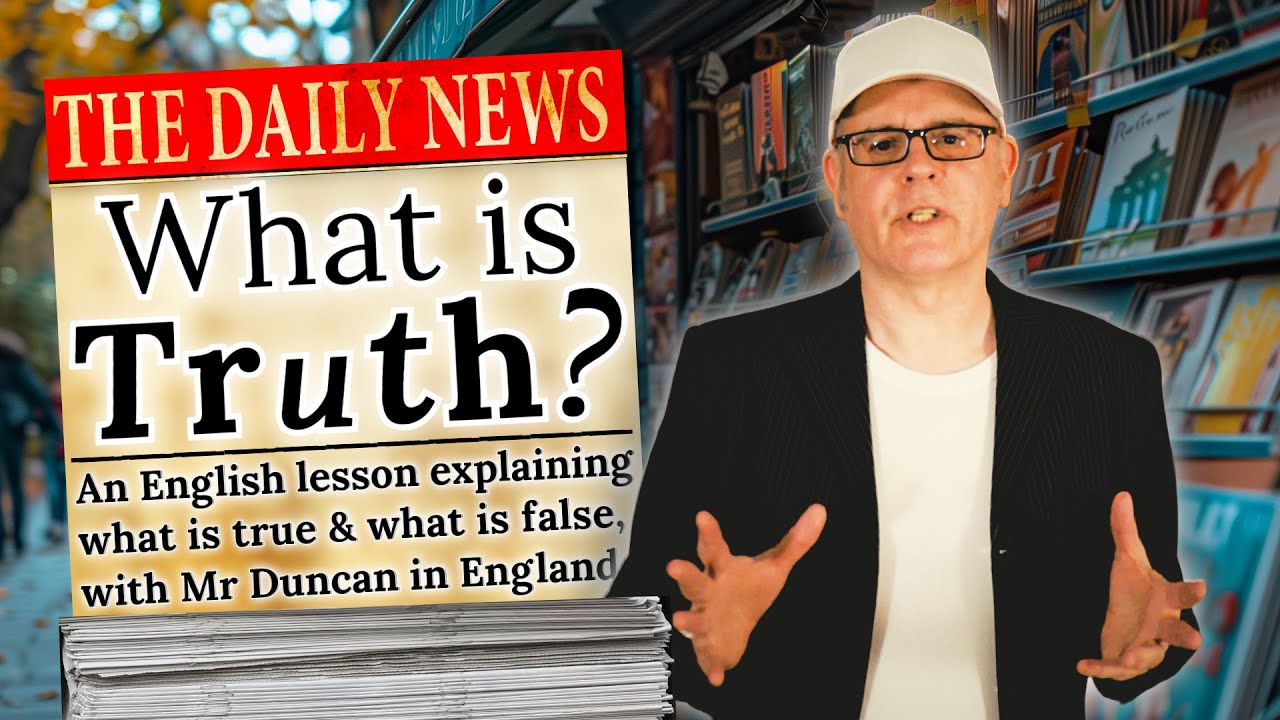
Shadowing practice: What is TRUE? What is REAL? What's the difference between TRUTH & FALSEHOOD? - An English Lesson
 Listen to the line, then say it out loud
Full transcript
- Here is a question many people are asking right now.0:00
- What is real?0:05
- By this we are questioning the world around us.0:08
- The things we see in our daily lives that may not be what they seem.0:11
- Something that appears real or true may in fact be false or fake.0:17
- This question can be stated in many different ways.0:23
- You are asking what is genuine and true.0:27
- You are wondering what to believe.0:31
- Is it real?0:35
- Is it true?0:36
- Should I trust what I hear?0:37
- How do I know when something is not factual?0:40
Show all 51 lines Show fewer lines
- We often use the words true and false to describe the impression we get from something.0:45
- True is real.0:52
- Genuine.0:54
- Actual.0:55
- A fact.0:56
- Trustworthy.0:58
- Reliable.0:59
- Verified.1:00
- And honest.1:02
- A true thing can be trusted.1:04
- As a statement the true thing said or written is the truth.1:07
- In law the truth is sought as a way of maintaining both fairness and justice.1:12
- The action of trusting someone or something is based on the firm belief that the thing seen or heard is true.1:18
- It is important to note that truth can be expressed as one sees it.1:27
- It is their point of view.1:32
- This type of statement is described as subjective.1:35
- It is one person's own point of view.1:39
- A statement based on fact or reality is described as being objective.1:42
- A discussion involving facts and proven things is objective.1:49
- A fake thing can also be described as artificial if it was created to appear or function in the same way as the real thing.1:55
- For example, an artificial limb or an artificial tree.2:06
- One might have no doubt about something.2:13
- I have no doubt that he is telling the truth.2:17
- To doubt is to question whether something is true.2:21
- I doubt he is being honest with us.2:26
- The word doubt conveys distrust or a lack of sureness about something.2:30
- The opposite of true is lie.2:37
- An untrue thing is a lie.2:41
- The opposite of truth is falsehood.2:44
- We often use the word true when describing what is real in the world around us.2:47
- Reality is what is real and true.2:53
- However, these days it is becoming much harder to instantly recognise when something is real.2:57
- The emergence of artificial intelligence has made it much harder to decide whether something is real or not.3:03
- The word fake is often used nowadays to describe something that is not true, genuine or real.3:13
- Fake news, fake information, fake facts.3:22
- Human intuition and fact checking are just two of the things that make sure what is untruly said, seen or heard will, for most of the time, be noticed.3:28
- The phrase truth will prevail helps to remind us that the most important thing to aim for and observe is the truth.3:41
- I really hope you've enjoyed today's lesson and please join me for another one real soon.3:53
- This is Mr Duncan in England saying thanks for watching, see you again and of course, ta ta for now.4:00
British English pronunciation practice from a B2 lesson on truth and falsehood
This clip is Mr Duncan working through the difference between what is true and what is real, delivered as a spoken essay rather than a conversation. It sits at B2 and moves at 144 words per minute, faster than most of the catalogue, so there is little room to drift while listening. The accent is standard British English, spoken clearly and evenly, which makes it useful for british english pronunciation practice before you move on to faster or more casual speakers.
Across 51 lines he builds an argument out of word pairs: true and false, genuine and fake, subjective and objective, doubt and trust. Because it is one voice reasoning aloud rather than two people talking, it works as much for english listening practice as for speaking practice: you have to follow where the definition goes next, then say it back in the same order he used.
The language in this clip: doubt, distrust, and the words for truth
The interesting part of this recording is how tightly packed the rare vocabulary is. In a handful of lines Mr Duncan uses conveys, falsehood, subjective, verified and factual, words a B2 learner recognises but rarely produces out loud. None of them are unusual outside this topic, but hearing them stacked together is what makes this recording harder than its wordcount suggests. Three lines are worth isolating before you try the whole passage.
- "A true thing can be trusted." is short enough to say in one breath, and the stress falls on trusted, not on true, which is easy to get backwards.
- "The word doubt conveys distrust or a lack of sureness about something." packs conveys, distrust and sureness into a single sentence, so saying it at his pace means hitting three rare words without slowing down.
- "The emergence of artificial intelligence has made it much harder to decide whether something is real or not." is the longest sentence in this stretch, a real test of keeping pace to the end instead of trailing off.
English shadowing practice B2: how to work through this truth and falsehood clip
Work through the passage in the order Mr Duncan built it, not by picking lines at random, since each part leans on the definition before it.
- Start with the short questions in lines 2 to 12, "Is it real?", "Is it true?", "Should I trust what I hear?": each is one breath, so repeat them on their own before moving further.
- Take the single word definitions in lines 14 to 21, "Genuine.", "Actual.", "A fact.", "Trustworthy.", "Reliable.", "Verified.", "And honest.": say each with a full stop's worth of weight, this is where the B2 word list actually sits.
- Isolate line 38, "The word doubt conveys distrust or a lack of sureness about something.", slow it down once, then bring it back up to his speed.
- Finish on line 45, "The emergence of artificial intelligence has made it much harder to decide whether something is real or not.", as a fluency check across the whole sentence.