Shadowing practice: How to be successful at LEARNING ENGLISH \ LESSON16 #englishaddict #duncanenglish
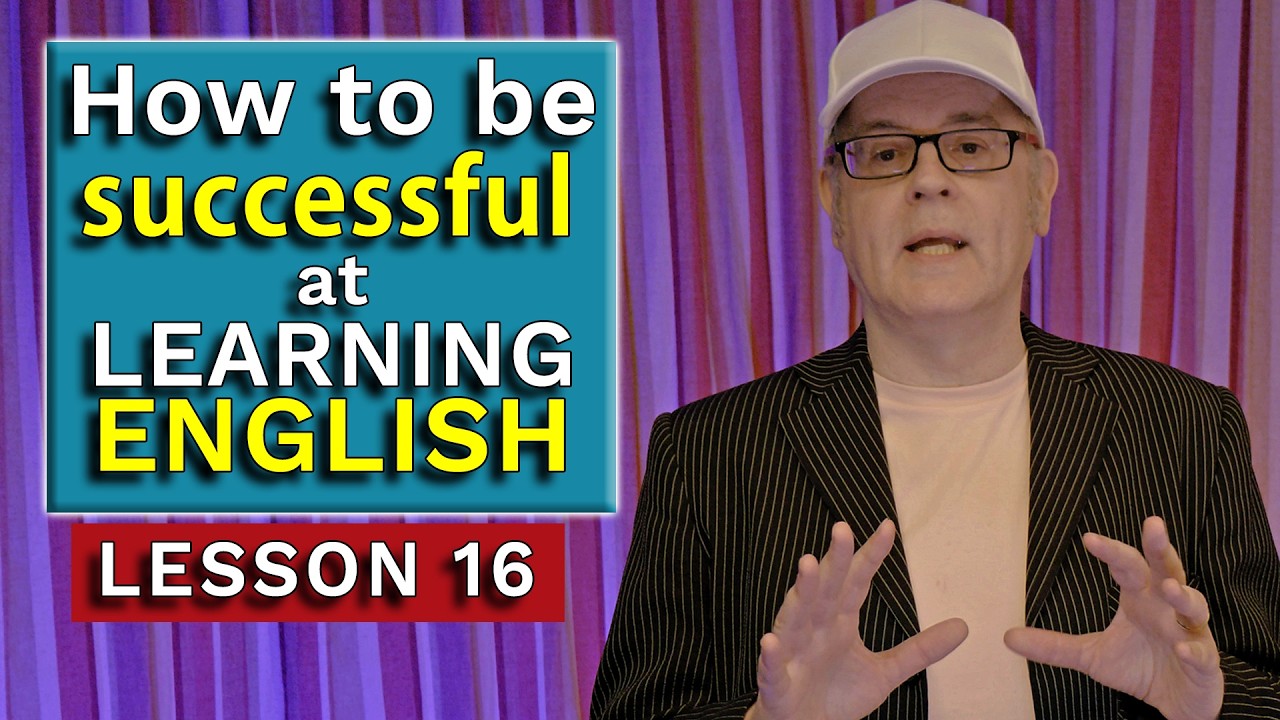 Listen to the line, then say it out loud
Full transcript
- What is success?0:01
- How do we measure it?0:04
- What exactly counts as being successful?0:06
- Today we will look at the word success and how it relates to doing anything in life, including learning English.0:09
- The word success is a noun that means the favourable outcome of something attempted, an action or performance that is characterised by success.0:18
- A person who attains success is someone who has achieved a favourable outcome of something they have pursued, such as a career in a certain field.0:31
- Something you have decided to do in your own life can lead to success.0:43
- We often view success as the attainment of wealth or fame, to be well known for something in a certain field, such as music, sport or business, can be viewed0:50
- as success.1:03
- A person has become successful.1:06
- The word successful is the adjective form of success.1:09
- A successful businessman, a successful shop owner, a successful singer, a successful English teacher.1:14
Show all 51 lines Show fewer lines
- We often view success as a big achievement.1:26
- However, it would also be fair to say that success can relate to smaller achievements as well.1:30
- A small goal that you reach could be described as a success.1:36
- Any achievement, be it large or small, can be described as a success.1:42
- Something you are trying to do, something you are pursuing as a hobby or a general activity can result in success.1:50
- You have achieved that thing with a positive outcome.2:02
- It is a success.2:06
- It is hard to escape the perception of success as meaning being wealthy.2:11
- We often see a wealthy person as successful.2:17
- It is natural to assume that a person has made all their money from a certain activity.2:21
- Of course, this can be misleading.2:29
- Having a large amount of money to your name does not necessarily mean you have achieved any type of success.2:32
- Some people might say that it is a type of illusion where money is used as a way of portraying success.2:40
- This is something that occurs often these days, especially on social media, where a person can present a successful appearance on camera whilst having no real success or ability whatsoever2:49
- in real life.3:05
- Of course, success can also relate to learning a subject, to achieve success in one study of a certain field such as science, art and of course, language.3:09
- In this case, I am talking about learning English.3:22
- If you want to be successful at learning something, then there are certain rules you must follow.3:26
- Putting lots of energy into learning something is vital for success.3:32
- Having the motivation to keep going will ensure that the outcome or result will be a personal success.3:39
- By this, I mean you will achieve your goal of understanding and hopefully using English in your daily life.3:48
- Motivation is what you use to keep moving forward.3:59
- You might describe motivation as the fuel in your engine.4:03
- Motivation is the enthusiasm and the urge to do something.4:08
- Giving yourself good reasons to do something is motivation.4:13
- Ask yourself, why do I want to learn English?4:19
- What is your reason for learning that particular language?4:24
- It is always good to set small goals for yourself.4:28
- With each goal you achieve, the further you move forward with your studies.4:32
- It is a gradual process.4:39
- It takes time.4:42
- It certainly can't be rushed.4:44
- By this, I mean with each small achievement you make, you will progress one step further towards your final goal, which is of course, to learn English well.4:48
- Motivation can also be described as enthusiasm.5:04
- You are enthusiastic.5:08
- You are motivated.5:11
- You are keen to reach the point when you can say you are successful.5:13
- Learning anything takes time and patience.5:18
- With each small achievement gained, that final goal of being successful in your English studies will become ever closer to being a reality.5:22
A British B2 Vocabulary Lecture for English Shadowing Practice
This clip is Mr Duncan explaining the word success, one clause at a time, at a British B2 pace of 136 words per minute. It is commentary, not conversation: a single speaker building a definition in front of you, first as the noun success, then as the adjective successful. That steady, explanatory delivery makes it a good source of english speaking practice, because almost every sentence is grammatically complete on its own, with no interruptions or crosstalk to chase.
The recording is filed under daily conversations but plays more like a spoken vocabulary class than banter between friends, closer to english listening practice for a lesson. Duncan defines success as the favourable outcome of something attempted before moving into concrete examples: a successful businessman, a successful shop owner, a successful English teacher. At B2, this is vocabulary you can reuse in your own sentences straight away, not words you file away for later.
British English Pronunciation Practice in Mr Duncan's Word Building
The interest here is sentence stress and how one word grows into three forms, useful british english pronunciation practice even though no reduced forms were measured in this recording. Duncan alternates short questions with long, layered definitions, and that rhythm shift is exactly what trips learners up when they try to match his pace.
- "How do we measure it?" is a short, clipped question, three of them arrive back to back at the start, each one a full breath on its own.
- "the favourable outcome of something attempted" sits inside a much longer sentence, practise it as its own unit before trying the sentence it belongs to.
- "It is hard to escape the perception of success as meaning being wealthy." carries five stressed content words in a row: hard, escape, perception, success, wealthy, said clearly enough at this pace that you can mark each one.
Working Through the First Twenty Lines of This B2 Success Lecture
Treat the opening as three short blocks rather than one long recording. This is where you practise english speaking against a speaker who never rushes a definition, which is what makes it worth returning to more than once.
- Lines 1 to 3, the three questions, say each one aloud with its own falling intonation before you let the recording move to line 4.
- Line 5, the noun definition, is the longest sentence in this stretch, shadow this line in two halves, splitting after attempted and picking up again at an action or performance.
- Lines 11 and 12, listen for successful repeated four times with a different noun each time, businessman, shop owner, singer, English teacher, then say the pattern back with your own noun.
- Lines 20 to 24, the wealth passage, slow this block down on a second pass and repeat "Of course, this can be misleading." until the two short clauses land as one unit, not two.
- Once you can say all four blocks without checking the transcript, run the whole eighteen lines straight through to hear your own accent settle into his pace, a fair way to improve your english accent on a clip this controlled.